




Tokenomics is a cryptocurrency’s economic model. It describes how the token is issued, distributed, used, and removed from circulation. It directly affects the asset’s value and prospects. And determines whether the token will grow in price or gradually depreciate. Economic models differ greatly across projects.
Tokenomics is developed either by specialized consulting firms or by the project creators themselves. The second option often fails: founders don’t always soberly assess their product’s future. Without understanding economics, it’s hard to create a model that sustains project interest. The key is not just to launch a token but to make it truly needed and in demand.
How well the team handled this is usually clear from the whitepaper — the project’s main technical document describing the token concept and its economic model. You can find it on the project’s official website.
What Tokenomics Consists Of
One of the main tokenomics parameters is total supply. This is the maximum number of tokens that can ever exist. When participating in a drop, people are primarily interested in this because tokens aren’t on the market yet and everyone awaits distribution.
There’s fixed supply: the maximum token volume is set upfront and never changes. This model creates scarcity and supports price. Another option is constant new token issuance without strict limits. That’s how Ethereum worked before switching to Proof-of-Stake. And the third is a hybrid system combining both approaches.
There’s also circulating supply — the number of tokens already in circulation and available for buying and selling right now.
Some projects have strictly limited token amounts. For example, Bitcoin has a maximum of 21 million coins, and there will never be more, increasing the token’s value. Others, like Dogecoin, issue coins infinitely — driving inflation like regular paper money.
Token distribution methods vary. Sometimes they’re given out immediately, sometimes gradually or after certain conditions. For instance, tokens for the team or early investors unlock gradually over months or years. This is called vesting. It keeps investors and participants interested in the project’s long-term success rather than dumping everything right after launch.
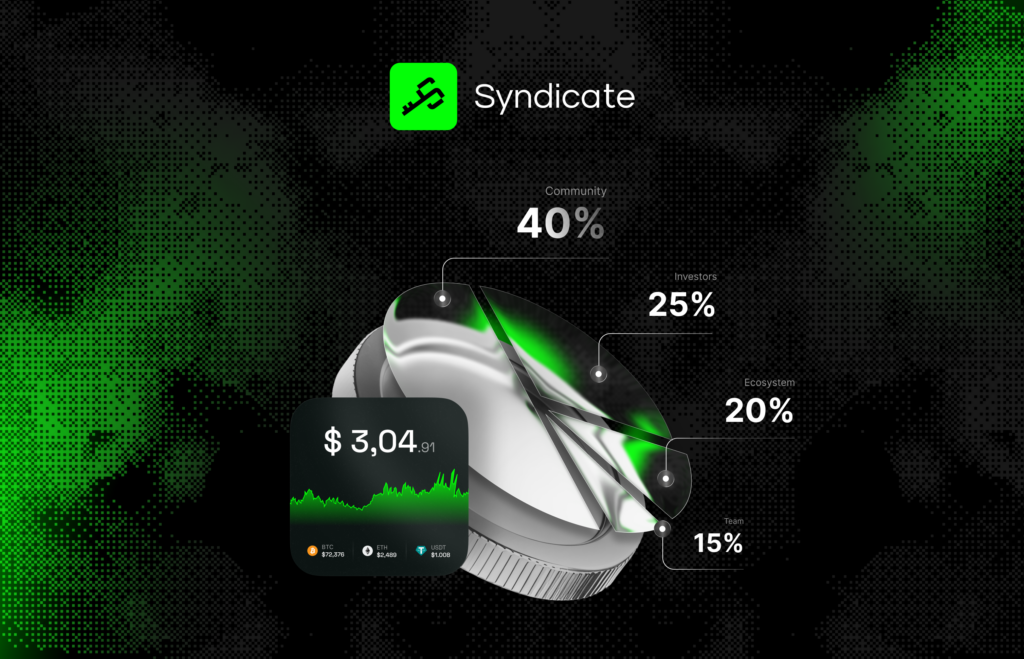
It’s also important to understand token allocation: how they were distributed from the start. In the crypto world, they’re actively used in early development stages. The project decides upfront who gets what share. Data on distribution is usually published in the whitepaper or on specialized platforms. Some projects disclose it fully, others partially. Opacity here is another red flag. They’re typically split between the project team (e.g., 10–15%), early investors, development fund, and community via rewards and airdrops. For small projects with limited budgets, this is especially convenient: tokens partially or fully replace cash payments. If the project grows in price, everyone involved wins.
Get More with Syndicate App


Balanced distribution is a sign of healthy tokenomics. If founders hold too large a share, there’s a risk of centralization in strategic decisions. And if investors hold a big share, there’s a risk of token dumps crashing the price.
What the Token Is Used For
The more real uses a token has within the project, the more sustainable its economy. The token can be used for paying fees, participating in voting and project governance, rewarding ecosystem participants, and securing the network in Proof-of-Stake models. If the token solves no tasks — that’s a red flag. It will quickly depreciate because no one needs it. Balance is key: the project provides utility, and its tokenomics creates a solid foundation for growth.
The token burning mechanism (burn) is the intentional destruction of part of them, reducing total circulating supply. The smaller the supply — the higher the potential value of remaining tokens. Conceptually, it’s like stock buybacks in traditional companies.
Burning can happen differently: a fixed percentage from each transaction, one-time events upon milestones, or automatic mechanisms tied to user activity.
To keep users active on the network, projects create reward systems. The most common are staking (locking tokens for rewards), liquidity farming (yield farming), loyalty programs, and gamified mechanics where activity directly converts to tokens.
Where to Look and How to Analyze a Project’s Tokenomics
All key tokenomics parameters are usually detailed in the project’s official documentation — the whitepaper. If you don’t want to dive into documents, check aggregators like CoinMarketCap: they present emission, distribution, and other token characteristics neatly.
Always check for team vesting — normally at least a year. If there’s none and 70-80% of tokens go to the team and investors, expect a dump right after listing. If you bought the token, you might go into the red post-listing while the team and early investors cash out. If you got the token free via airdrop, worst case you just wasted time. Best case — you sold at launch and profited alongside the team and investors.
If 20-30% is allocated to the token launch stage (TGE) — expect a sharp price drop. Because all those tokens hit the market immediately. The normal option is gradual vesting: unlocks of 2-4% per month over one to two years.
Tokenomics analysis answers key questions: will there be price pressure from upcoming unlocks, does the asset have real value, or is all interest just hype.
Even a quick review of basics — total token count, distribution, and use cases — gives enough info for an informed decision. It’s no profit guarantee, but way better than impulsive investments without understanding what you’re buying.

Share this post
Link copied!