




But it has not disappeared — it has compressed in volume, shifted structurally, and lost its position as the market’s primary narrative. OpenSea has become a real-world case of how even a dominant category leader can gradually lose weight and be forced to pivot its focus.
NFT hype peak in 2021–2022 vs. 2026: numbers and context
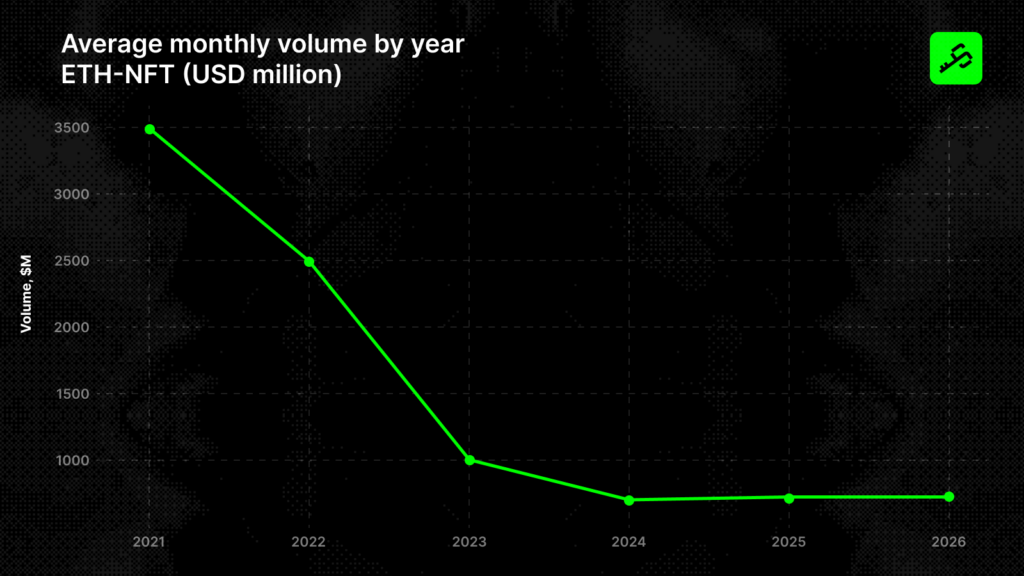
In 2021–2022, NFTs dominated with monthly ETH-NFT volumes of around $3.5 billion and weekly peaks reaching $2 billion (August 2021). By 2023, volumes dropped to around $1 billion, to ~$700 million in 2024, and in 2025–2026 they stabilized at approximately $720 million per month. At the same time, 42% of 2022 wallets remain active, and total market capitalization is still measured in tens of billions of dollars.
The idea of a “dead trend” here refers to narrative and retail hype, not the literal disappearance of the market. Retail speculation and fast multiples are gone, while utility-driven use cases (gaming, ticketing, loyalty) and enterprise integrations have moved to the forefront — although they do not generate the same level of virality.
What OpenSea looked like at its peak
At the height of NFT mania, OpenSea was effectively synonymous with the market. In 2021–2022, it was the largest marketplace by volume, and between 2022 and 2024 it processed more than $23 billion in cumulative NFT trading volume — more than any competitor. In January 2022, OpenSea generated up to $125 million in monthly revenue, with a valuation reaching approximately $13.3 billion. This made it one of the most valuable crypto companies of that period.
OpenSea accounted for up to ~70% of the NFT market by some metrics in 2023. Even after competitors entered, its share remained around 50% compared to ~37% for Magic Eden. At the time, it seemed like a “permanent” monopolist of NFT trading — a platform around which long-term strategies could be built, with expectations of a substantial token drop.
OpenSea volume decline over time
The chart shows a dramatic drop in OpenSea activity: from market-leading peaks to a more niche platform increasingly focused beyond NFTs.
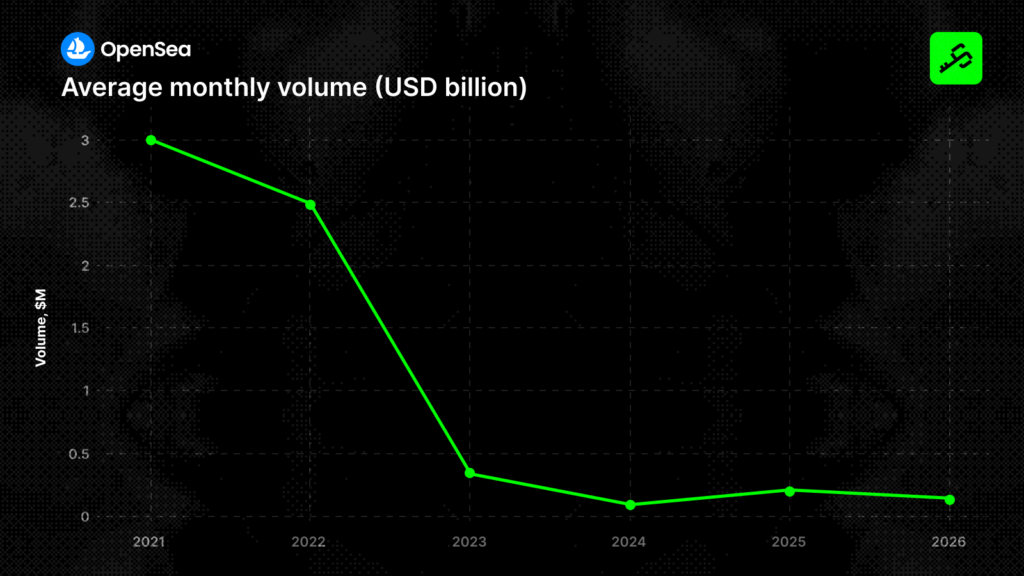
Trading volumes on OpenSea collapsed from peak levels of around $3 billion per month in 2021 (70–80% of the total NFT market during the hype) and ~$2.5 billion in 2022 (peak demand), to ~$0.35 billion in 2023 (sharp decline, revenue down to ~$3 million, layoffs), ~$0.1 billion in 2024 (competition from Blur and Magic Eden), a rebound to ~$0.2 billion in 2025 (token announcements), and stabilization at around ~$0.15 billion in 2026, where NFT activity is уступed by non-NFT segments.
The OpenSea case: from NFT marketplace to a multi-asset hub
OpenSea is shifting its focus from NFTs to broader on-chain trading. The platform is evolving into a cross-asset hub where users can not only trade NFTs but also swap tokens, interact with other asset classes, and use DeFi tools.
Key steps:
- launch of the $SEA token (staking, governance, buybacks);
- expansion into new assets: ERC-20 tokens, perpetuals, tokenized real-world assets, support for 20+ networks and cross-chain liquidity;
- development of a mobile app with integrated token swaps and on-platform purchases.
Conclusion: OpenSea is moving away from a pure NFT marketplace model toward an “all-in-one” on-chain trading hub, where NFTs are just one part of a broader ecosystem.
Narrative instability: TGE, delays, and trust
Another key layer is the expectation around the token and the airdrop. The announcement of $SEA, with initial guidance pointing to Q1 2026, boosted user activity: participants actively completed quests and farmed XP, expecting a generous drop similar to other protocols.
But in reality:
- TGE dates have already been postponed multiple times, and no clear launch window has been firmly established;
- delays are creating fatigue within the community, especially among users who spent time engaging in the Voyages program in anticipation of future rewards;
- as long as the token is not live, the entire gamification and reward system feels incomplete — there is no transparent metric showing how accumulated user “effort” will convert into value.
As a result, a conflicting narrative is forming around OpenSea: on one hand, it remains a large-scale player with liquidity and a multi-asset strategy; on the other, the prolonged token launch and repeated delays are eroding trust and devaluing user activity. This creates the impression of an “unfinished product.”
Ultimately, the platform risks being perceived not as a market leader, but as just another on-chain hub without clear timing or a strong narrative in the current cycle. The longer this uncertainty persists, the lower expectations become regarding the quality and size of the airdrop. Prolonged campaigns dilute reward value, leaving the project with less room to positively surprise its users.
Read next
How to Identify NFT Airdrop Scams
Share this post
Link copied!