




Polymarket is one of the strongest projects in the prediction markets narrative, where users trade on the outcomes of real-world events: elections, sports, crypto, macro, politics, and news. In practice, you buy “Yes” or “No,” and the price reflects the market’s estimate of probability: if “Yes” costs $0.70, the market is pricing the event at roughly 70%.
Polymarket has stopped being just a “crypto betting app” and has become a project where major financial infrastructure is getting involved. ICE, the owner of the New York Stock Exchange, invested $1 billion in Polymarket in October 2025 and another $600 million in March 2026. Total investment in the project has reached $2.88 billion. And that’s not the only scale signal: Dow Jones signed an agreement to use Polymarket data across its media properties, including The Wall Street Journal, Barron’s, and MarketWatch.
But the main point is this: the prediction markets niche itself has huge appeal. It’s one of the few crypto products that even people with no prior crypto background can understand immediately: you pick an event and bet on its outcome. That’s why prediction markets are no longer just a narrow Web3 topic and are turning into a mass-market tool that now interests not only crypto users but also giant traditional finance firms, media, and everyday users.
The main trigger for farmers is simple: Polymarket CMO Matthew Modabber publicly said:
“There will be a token, there will be an airdrop”
but the team has not officially revealed exact criteria, timing, or allocation. So the goal now is not to “farm volume blindly,” but to do activity that can look like real, useful user behavior.
Key farming metrics
For Polymarket, it makes sense to follow the logic of similar prediction-market projects and what matters to the platform itself.
For example, Limitless airdrop design is merit-based: it considers trading volume, liquidity provision, market participation quality, and referral activity. A minimum trading volume of $200 for participation was also mentioned.
Polymarket already has an official liquidity rewards program: competitive limit orders, order-book depth, market participation, and tighter spreads versus the midpoint are rewarded.
That gives us the likely Polymarket farming metrics: trading volume, number of trades, active days, number of different markets, real PnL, participation in reward markets, liquidity provision, and the absence of obvious Sybil behavior. Profitable all-time PnL would be an extra plus.
Strategy 1. Trade high-probability markets
The simplest strategy is to enter events where the outcome probability is already above 90%. For example, the market prices “Yes” at $0.95. If the event really happens, your share settles at $1. So the potential profit is small — around 5% before fees and spread — but you build volume and activity with much less risk than in a 50/50 market.
The point here is not to make multiples on the bet itself. The goal is to stay roughly flat, make a small profit, and at the same time work through the possible airdrop metrics: trades, volume, active days, and participation across different markets.
A good example is extreme-scenario markets, such as oil.
For instance, if the question is: “Will oil reach $200 by the end of May?” and the “No” side is priced around 99.7 cents, the market is almost certain that it won’t happen. A $2,000 position would return about $6 in profit, but the real point is not the income — it’s the trading volume on the account. The same mechanic can be repeated on levels like $180, $150, $140, and $130 to build activity faster.
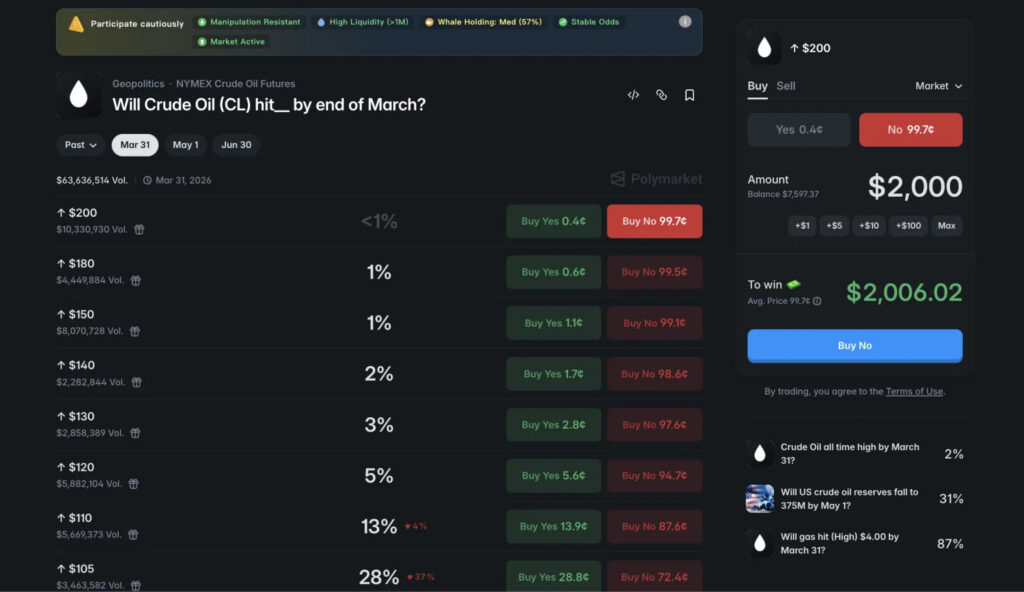
It’s better to choose liquid events with clear rules and a near-term resolution date. Markets with 90–99% probability are suitable for careful volume building. Remember: even 99% is not a guarantee, and unexpected outcomes still happen.
Strategy 2. Cross-platform arbitrage
The second strategy is to look for the same event on different prediction-market platforms and capture the price difference. For example, the same event may exist on Polymarket and on another platform like Opinion, Limitless, or Kalshi. If “Yes” is cheaper on Polymarket and “No” is also cheap on the other platform, you can open opposite positions and almost lock in the result.
Example: on Polymarket, you buy “Yes” for $0.47, and on another platform you buy “No” for the same event for $0.50. Total cost of the two positions is $0.97. If the settlement rules are the same, one of the outcomes should pay $1. Potential spread: $0.03 per pair, before fees, spread, and slippage.
The upside of this strategy is that you’re not only farming a potential airdrop, you may also profit from market inefficiencies. The downside is that this is a more complex mechanic. You need to compare market rules carefully: dates, wording, resolution sources, time zones, and cancellation conditions. If “the same event” is actually defined differently on the two platforms, arbitrage can turn into plain risk.
Example: UEFA Champions League 2026 — Arsenal to win. Trade: buy YES shares on Polymarket (cheaper) and NO on Limitless (cheaper). Put $100 into each side.
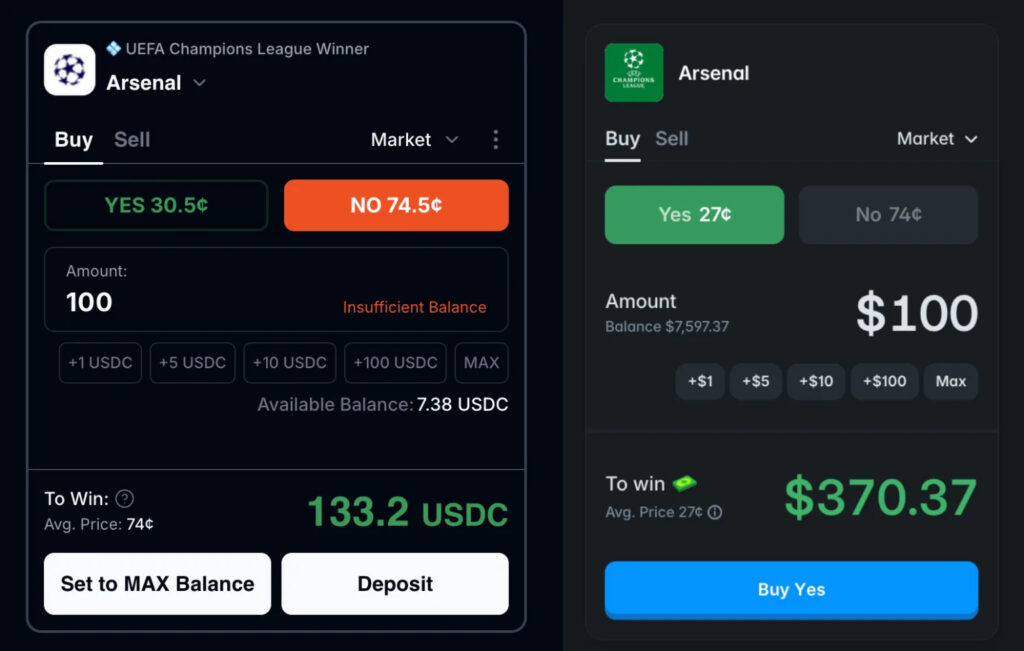
If Arsenal wins: the YES shares on Polymarket worth $100 would be worth $370.37; the NO position worth $100 is lost. Net profit: $270.37. If Arsenal does not win: the NO shares on Limitless worth $100 would be worth $133.20; the YES position on Polymarket worth $100 is lost. Net profit: $33.20.
Either way, there is no losing outcome. You generate trading volume on both Polymarket and Limitless, build activity across multiple wallets, and make a profit — which makes arbitrage the cleanest strategy in this toolkit.
Strategy 3. Provide liquidity
The third strategy is the most underrated. Instead of just buying “Yes” or “No,” you can place limit orders and help the market become more liquid. Polymarket directly pays liquidity rewards: the more useful your orders are to the market, the closer they are to the midpoint, and the more competitive your size and pricing are, the more you can earn. Payouts are credited daily, and the minimum payout is $1.
Why can this be especially interesting for a potential airdrop? Because there are many regular traders, but noticeably fewer liquidity providers. Fewer than 2% of active Polymarket wallets have ever earned more than $1 from providing liquidity. If Polymarket rewards not just volume but real usefulness to the platform, LP activity could become a strong filter.
The idea is simple: you choose markets with a reward program, place limit orders close to the current price, and receive USDC rewards for improving the order book. This kills two birds with one stone: you farm a potential airdrop and can also receive real USDC payouts at the same time.
But there is a risk: if the market moves sharply against you, your order may get filled and you’ll be left with a position that needs to be closed. So it’s better to start with small amounts, liquid markets, and clear events.
Share this post
Link copied!