






Over the past two years, prediction markets have become one of the most talked-about sectors in the crypto industry. Platforms where users bet on the outcomes of real-world events — from elections to the price of Bitcoin — are активно attracting attention from investors, analysts, and the broader crypto community.
At first glance, the idea makes sense: prediction markets have existed for decades, and blockchain enables them to become global, transparent, and accessible to everyone. However, if you take a closer look at the actual metrics, a question arises: is this truly a sustainable product, or just another hype-driven narrative that could repeat the fate of the 2021 NFT boom?
Why prediction markets became popular
Interest in prediction markets surged in 2024–2025. The main reasons:
- the growing popularity of platforms like Polymarket
- integration of prediction markets into political events (e.g., elections)
- simple mechanics: betting on outcomes instead of complex token trading
- the opportunity to profit from analyzing real-world events
In essence, prediction markets are positioned as a new type of financial market where price reflects the probability of an event. For example: “BTC will be above $100k by year-end,” “Who will win the election,” “Will the ETF be approved.”
The key question is: to what extent are these markets actually used by regular users?
Metrics often look better than reality
Many prediction market platforms showcase impressive numbers: hundreds of millions of dollars in trading volume, tens of millions in TVL, and thousands of event markets.
But the crypto market has been through similar narratives before.
In 2021, the NFT market also looked like a mass product: massive trading volumes and millions of users. Later, it turned out that a significant portion of the activity was driven by speculation, wash trading, multi-accounts, and airdrop farming for rewards. A similar pattern is starting to emerge in prediction markets.
What happened after the Opinion token launch
One of the first major prediction market projects to launch its own token was Opinion.
Before the token launch, the platform showed steady TVL growth.
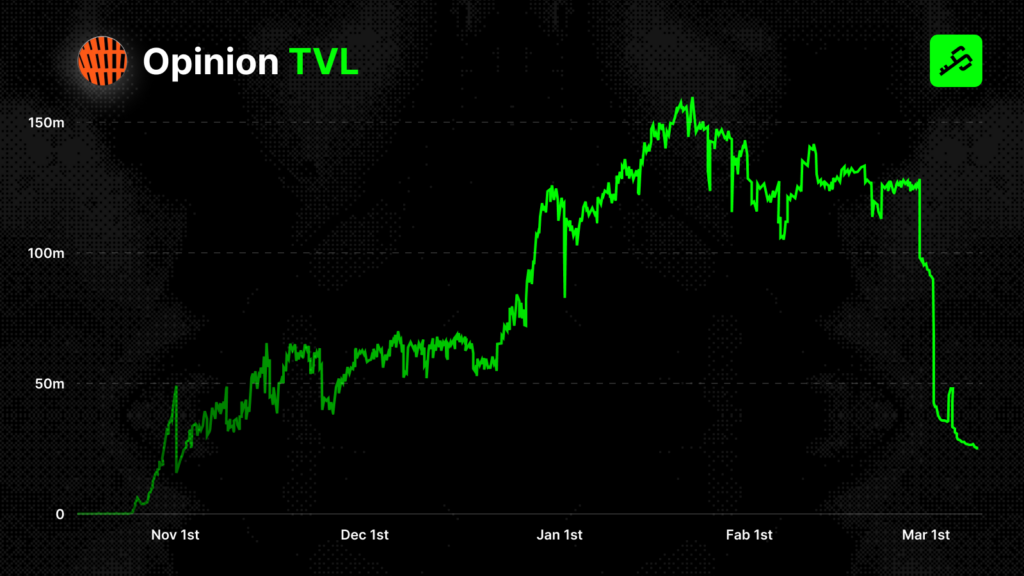
As seen in the chart, the platform’s TVL was gradually increasing and reached around $150 million. However, after the token launch, the situation changed резко: TVL on the platform dropped by approximately 80%. This is an important signal when analyzing real product demand.
If users were genuinely using the platform to forecast events, the token launch should not have triggered such a significant liquidity outflow.
The sharp decline suggests a different picture. A large share of the liquidity was likely not driven by real users, but by:
- airdrop farmers
- multi-accounts
- bots
- temporary liquidity aimed at earning tokens
After the airdrop rewards were distributed, these participants simply left the platform.
Activity issues on Polymarket
Polymarket is considered the largest prediction market project in the space. However, even here the situation is far from perfect.
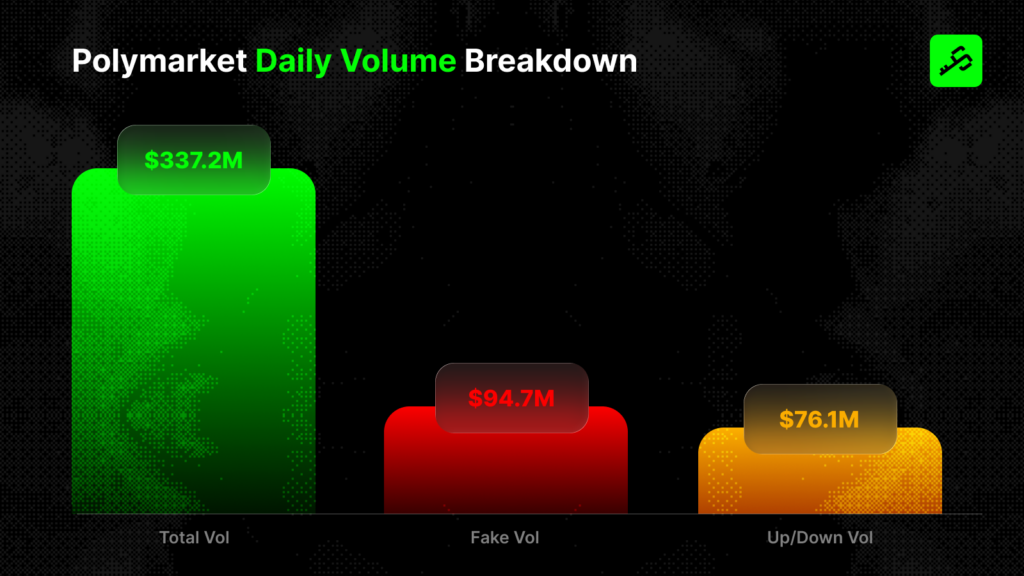
According to analytical data:
- total daily volume was around $337 million
- approximately $94.7 million (28%) may come from airdrop farmers trading in “dead” markets to boost wallet activity
- around $76 million (23%) is generated by bots automatically opening and closing positions
Nearly half of the trading volume may not be tied to genuine user predictions, but to technical or farming activity aimed at future airdrops. This does not mean the product isn’t used at all, but real demand may be significantly lower than reported figures suggest.
Why this happens
There are several reasons why prediction market metrics can look significantly better than actual user activity. First and foremost, this is driven by airdrop farming. Much of the activity in new crypto projects today revolves around ожидание future tokens. Users create dozens of wallets, repeat the same actions, and inflate trading volumes simply to improve their account statistics and receive more tokens during distribution.
Additional activity comes from bots — automated algorithms that can open and close positions with little to no human involvement. This creates trading volumes that resemble real demand, while in reality it is technical activity.
Finally, prediction markets still remain a niche product. For most people, it is far easier to use traditional betting platforms or simply follow the news than to participate in crypto-based prediction markets. As a result, the real number of users of these services is significantly lower than their activity metrics might suggest.
Does this mean prediction markets are a failure?
Not necessarily. The idea of prediction markets has a strong theoretical foundation. These markets can indeed aggregate collective intelligence and sometimes produce more accurate forecasts than traditional polling.
Current metrics may be heavily distorted by crypto economics — airdrops and speculation. Therefore, activity figures do not always reflect real product usage.
Key takeaway
Today, the crypto industry is still in the stage of a narrative-driven economy. Most new projects grow not so much due to real product demand, but because of hype, expectations of future tokens, and the opportunity to profit from emerging trends.
Prediction markets may prove to be a useful tool and could eventually carve out a real niche. However, current metrics suggest that the actual number of users is significantly lower than TVL and trading volume data imply.
As with NFTs, the market may go through an overheating phase, after which only a few truly востребованных platforms will remain. For now, prediction markets are both an interesting technological experiment and another example of how the crypto market turns any new product into an investment narrative.

Share this post
Link copied!