


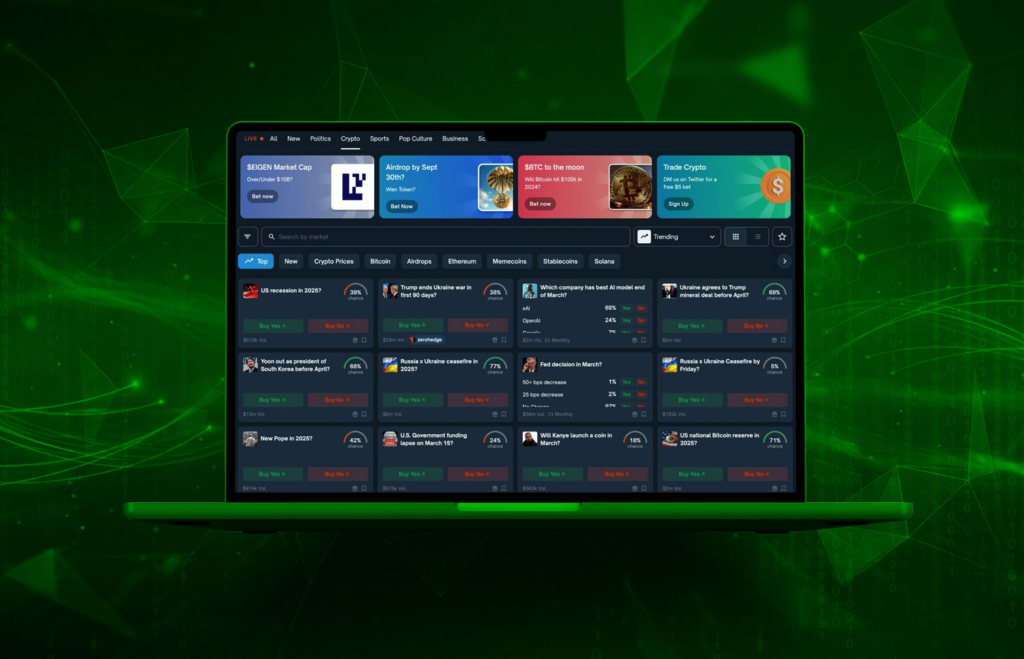



By February 2026, they have transformed into a fully fledged financial instrument that is reshaping the rules not only within the crypto industry, but across traditional finance as a whole.
From $100 Million to $13 Billion: Two Years That Changed Everything
Monthly trading volume on these platforms has surpassed $13 billion — and that is only the nominal figure. Considering that at the beginning of 2024 it barely reached $100 million, the scale of change is truly staggering. In just two years, the market has grown 130-fold. Few sectors in fintech history can claim a similar trajectory.
But growth is not only about money. Prediction markets have become a mass phenomenon in the literal sense. The number of transactions surged from 240,000 to 43 million per month — a 179-fold increase. Active users exceeded 600,000, excluding Kalshi’s audience, which is not included in these statistics.
Open interest also deserves special attention — it reached $843 million. This metric is important because it reflects not speculative hype, but real commitments by market participants. These figures show that people are not coming here just to play around — they are using these platforms as hedging and investment tools.
While TVL Stalls, Trading Volume Soars
Total sector TVL, according to TokenTerminal, amounted to $534 million. At the same time, capital is distributed far from evenly among players — the picture is notably asymmetric and deserves separate discussion.
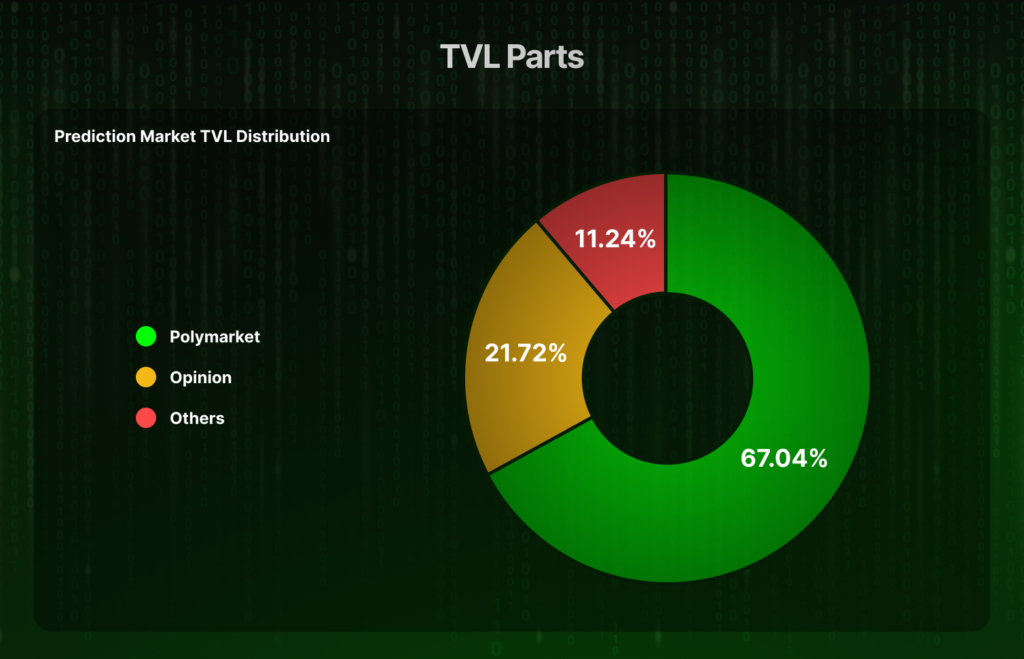
When it comes to specific players, the situation is quite clear: Polymarket dominates. $358 million in TVL and 67% market share is not just leadership — it is industrial-standard status that is difficult to challenge. Opinion ranks second with $116 million and 22% market share — an impressive result, especially considering the project is relatively new. The remaining platforms split the remaining 11%.
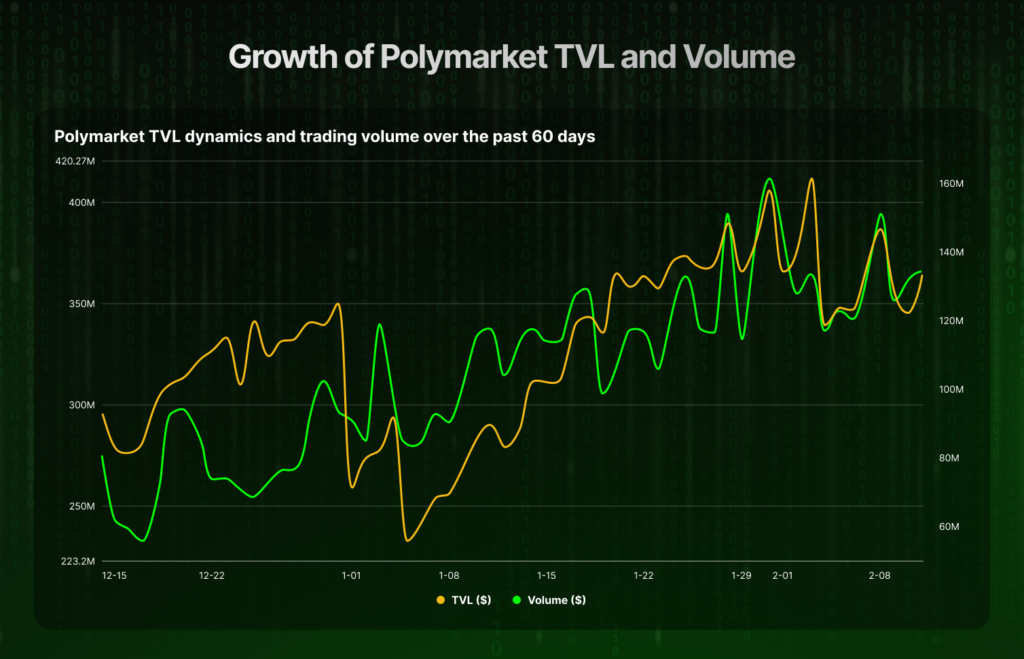
However, it is far more interesting to look not at who holds what, but at what is happening with the dynamics. Polymarket’s data over the past 60 days reveals a subtle yet telling trend. TVL remained almost unchanged: $316 million in December versus $319 million in January — growth of less than one percent. Meanwhile, trading volume over the same period surged by 148% — from $1.42 billion to $3.53 billion per month.
What does this mean in practice? Capital in the system is no longer sitting idle — it is moving. The market has shifted from passive capital holding to active trading. The average daily trading volume over the last 30 days reached $126 million — making prediction markets one of the most liquid segments across DeFi.
From Entertainment to Hedging: A Shift in Audience
In the past, prediction markets were almost synonymous with elections and football matches. Who will become president? Which team will win the championship? That was the entire repertoire. But as of 2026, this picture has changed dramatically — and this shift clearly signals that the instrument has matured.
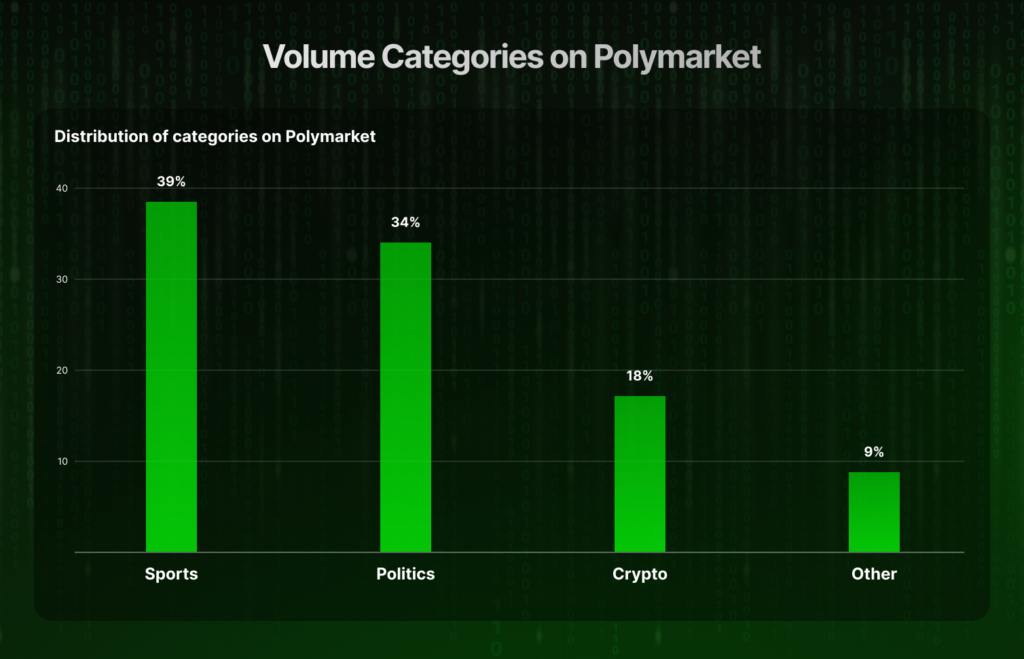
On Polymarket, sports account for the largest share — 39%, followed by politics at 34%, crypto at 18%, and other categories at 9%. At first glance, it may seem that nothing has fundamentally changed. But a deeper look reveals a very different picture.
The fastest-growing categories are precisely those that barely existed on these platforms before. Trading volume in the “Economy” category grew by 905% in 2025 — reaching $112 million. “Technology & Science” showed even more dramatic growth: +1637%, reaching $123 million. These are no longer niche curiosities — they are fully developed markets with serious capital behind them.
Behind these numbers lies something more important than statistics. Prediction markets are gradually ceasing to be a venue for entertainment betting and are becoming tools for dealing with real uncertainty — macroeconomic risks, technological breakthroughs, corporate decisions. Participants come not just to speculate, but to hedge or extract information that traditional markets fail to provide.
Kalshi, Polymarket, Opinion: Who Plays and How
Today’s prediction market landscape is not a monolithic industry, but an arena where fundamentally different philosophies and business models collide.
Kalshi operates under traditional finance rules. Regulated status, standardized contracts, and a focus on sports events — 85% of its volume comes from them. But this approach should not be underestimated: $100 billion in annual trading volume demonstrates that a regulated environment has its own audience and advantages.
Polymarket has chosen the opposite path — decentralization and maximum thematic breadth. This allowed it to become the leader in the crypto niche and maintain 67% of the market by TVL. Technically, the platform is built on Polygon, ensuring low fees and fast transactions — critical when the primary flow consists of a large number of small trades.
Opinion holds third place, but with a clear identity. The platform focused on macroeconomic markets and institutional users — and it paid off. Third place in open interest after Kalshi and Polymarket demonstrates that demand for specialized hedging instruments for economic risks is real and continues to grow. Three players, three different bets on the future — and so far, each has found its niche.
Info-Finance and AI: What Could Change Everything
Prediction markets influence the crypto industry far more deeply than may appear at first glance. They are not just another blockchain application — they are a catalyst pulling entire market segments forward.
Most trades on these platforms are denominated in USDC and USDT, creating stable and organic demand for stablecoins. Polymarket alone has reached $20 billion in total trading volume — a figure that already represents a significant share of the broader stablecoin circulation within the industry.
At the same time, the blockchain networks hosting these platforms are growing as well. Polymarket on Polygon, Jupiter on Solana — both illustrate the same logic: a specialized application with mass demand becomes a growth engine for an entire ecosystem. Low fees and high throughput are not merely conveniences — they are technical necessities. Without them, a market built on small trades simply cannot function.
But the most interesting developments are happening at the conceptual level. Prediction markets are giving rise to what is increasingly referred to as “Info-Finance” — informational finance. Here, price reflects not only supply and demand, but the collective assessment of the probability of future events. This represents an entirely new financial layer, opening space for derivatives and structured products that previously did not exist.
And finally — what could change everything. According to Delphi Digital, 2026 will be the year of AI agents autonomously trading on prediction markets without human intervention. If that materializes, liquidity and forecasting accuracy could grow exponentially. Humans ask the questions, the market aggregates knowledge, AI executes trades — and the entire system begins operating at a fundamentally different speed.
The Other Side of Growth
It would be unfair to speak only about successes. Growth has brought challenges — real ones, and without obvious solutions for now.
The first and most fundamental is regulatory uncertainty. The CFTC and other regulators are closely monitoring this space, and the legal classification of prediction markets remains open. Are they financial instruments? Or gambling? The confrontation between Polymarket’s decentralized model and Kalshi’s regulated approach is not merely competition between two companies — it is effectively a test case for the entire industry, one that will shape its future.
Insider trading is another concern. The decentralized nature of these platforms — their strength — is also a vulnerability, as tracking abuse is far more difficult than on traditional exchanges. A telling example was a bet on the resignation of Venezuela’s president that generated a 10x return. Technically, nothing was violated. But questions about the source of information remain unanswered — and such cases fuel regulatory skepticism.
There are also technical risks that are less frequently discussed publicly. Prediction markets critically depend on oracles — external data sources that determine event outcomes. Errors or manipulation at this level could lead to significant losses for participants, and current safeguards remain insufficient.
Finally, liquidity. Large markets — elections, championships, macroeconomic events — function well. But most niche markets suffer from insufficient participation, making them vulnerable to manipulation and significantly limiting their practical value as hedging tools. The paradox is clear: the more specific the risk one wants to hedge, the harder it is to find a counterparty.
2026–2027: What Comes Next
In 2026, prediction markets have definitively ceased to be an experiment. They are a fully formed financial market with volumes capable of competing with traditional exchanges, and with an influence on the crypto industry that is difficult to overestimate. Stablecoins, scalable networks, new financial primitives — the growth of prediction markets stands behind much of this development.
What comes next? Several parallel processes are unfolding simultaneously. Institutional players are no longer observing from the sidelines. According to KPMG, they are entering these markets with concrete objectives: prop trading, corporate forecasting, hedging. These are not pilot projects — they reflect a shift in perception toward the instrument itself.
At the same time, convergence with traditional finance is accelerating. Kalshi’s integration with Jupiter on Solana is just one example of how decentralized and classical finance are beginning to speak the same language. This process is only beginning.
However, growth demands stronger infrastructure. More reliable oracles, improved liquidity mechanisms, standardized frameworks for market creation — without these, scalability will inevitably face limits.
And finally — geography. Prediction markets have particular potential in countries where traditional financial instruments are either inaccessible or unreliable. For millions of people, this could become the first real way to hedge against economic uncertainty.
Ultimately, prediction markets aspire to become a kind of crystal ball for global finance — a tool that not only reflects expectations, but actively shapes them through price discovery and risk distribution. Whether they remain a niche phenomenon for insiders or evolve into a global standard of informational infrastructure is a question that will be answered in the coming years.

Share this post
Link copied!