






We break down how they work, their collateral models, explosive growth, and their role as a bridge between crypto and traditional finance.
What Is a Stablecoin?
A stablecoin is a cryptocurrency pegged to a stable asset, most commonly the U.S. dollar (≈$1). They are designed to move funds quickly within the crypto ecosystem without sharp price swings and without constantly cashing out into fiat currencies like dollars or euros.
The most popular examples are:
- USDT — the most liquid and widely used stablecoin
- USDC — transparent and aligned with regulatory standards
- DAI — decentralized and widely used in DeFi
USDT dominates trading volumes and transfers between exchanges. USDC ranks second and is often viewed as a more compliance-friendly option thanks to public reserve attestations and cooperation with regulators. DAI remains popular among DeFi users because it is more decentralized and deeply integrated into on-chain finance.
Beyond these, the role of FDUSD, PYUSD, USDe, and other stablecoins is growing as the market becomes more fragmented across jurisdictions, yield strategies, and use cases.
It is important to understand that a stablecoin is not a “magically stable” token. Its reliability depends entirely on what backs it — reserves, collateral, or algorithms — and that determines market trust.
What Backs Stablecoins?
There are several models used to maintain stability.
- Fiat-Backed Stablecoins. Each token is backed by real dollars (or euros) held in reserve accounts.
- Crypto-Collateralized Stablecoins. The token is backed by cryptocurrency deposited as collateral with excess coverage. For example, $100 worth of stablecoins may be backed by $150–200 worth of crypto.
- Hybrid / Yield-Bearing Models. Some stablecoins are partially backed by income-generating assets such as Treasury bills. The issuer earns yield on those reserves.
When you buy a stablecoin, the issuer receives your dollar and may invest it into short-term government bonds yielding 4–5% annually. The token remains pegged to $1 while the company earns interest on reserves.
USDT, USDC, and similar tokens are backed by cash reserves, short-term Treasuries, and liquid equivalents. DAI is backed through crypto collateral and smart contracts.
Algorithmic Stablecoins. These attempt to maintain the peg through mint-and-burn mechanisms. If the price rises, the system issues more tokens. If it falls, tokens are removed from circulation. This model has historically proven to be the riskiest in crypto.
Yield-Bearing / RWA-Backed Stablecoins. A newer category backed partly by real-world assets such as government bonds and other tokenized instruments.
Why Are There So Many Stablecoins?
Stablecoins solve multiple problems at once: trading, transfers, store of value, onchain settlements, yield generation. Different users prioritize different things:
- Some want a trusted issuer and transparency
- Others want decentralization and independence from banks
- Others need access to dollar-like assets in unstable local economies
That is why the market has not converged around one “perfect” stablecoin. Some users choose USDT for liquidity, others USDC for regulation, and others DAI for DeFi-native logic and minimal reliance on centralized issuers.
Why the Sector Grew So Fast
Stablecoins became the most efficient bridge between crypto and traditional money.
They allow users to:
- Move money 24/7
- Enter and exit volatile assets quickly
- Send funds internationally without banks or delays
- Hold dollar exposure globally
Growth accelerated further as major institutions entered the space. Banks began exploring their own stablecoins, while Europe and the U.S. introduced clearer regulatory frameworks. This increased trust. But most importantly, stablecoins moved beyond crypto speculation.
Today, regular people use them to: to receive salaries, accept freelance payments, send remittances abroad. Real-world assets such as bonds and financial products are also increasingly being tokenized through stablecoin infrastructure, making them faster and easier to trade on blockchain rails.
Market Capitalization Growth
The total stablecoin market cap shows that after a sharp decline in 2022–2023, the sector rebounded strongly and reached new highs by 2025–2026.
- 2021: around $170B
- 2022: around $138B, decline after market cooling
- 2023: flat near $138B
- 2024: recovery to roughly $220B
- 2025–2026: acceleration to $315B+
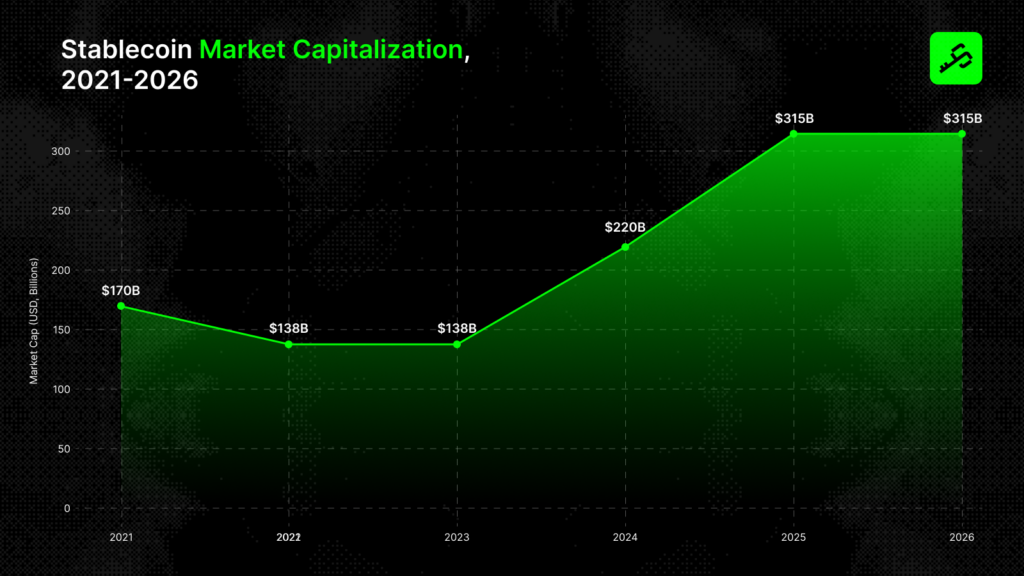
The market went through a cleansing phase and returned stronger on a more mature foundation. Stablecoins have become core infrastructure for crypto markets and are increasingly used in traditional finance.
Growth is no longer driven only by retail users — large institutions now use stablecoins for settlements and blockchain-based transactions.
Trading Volume
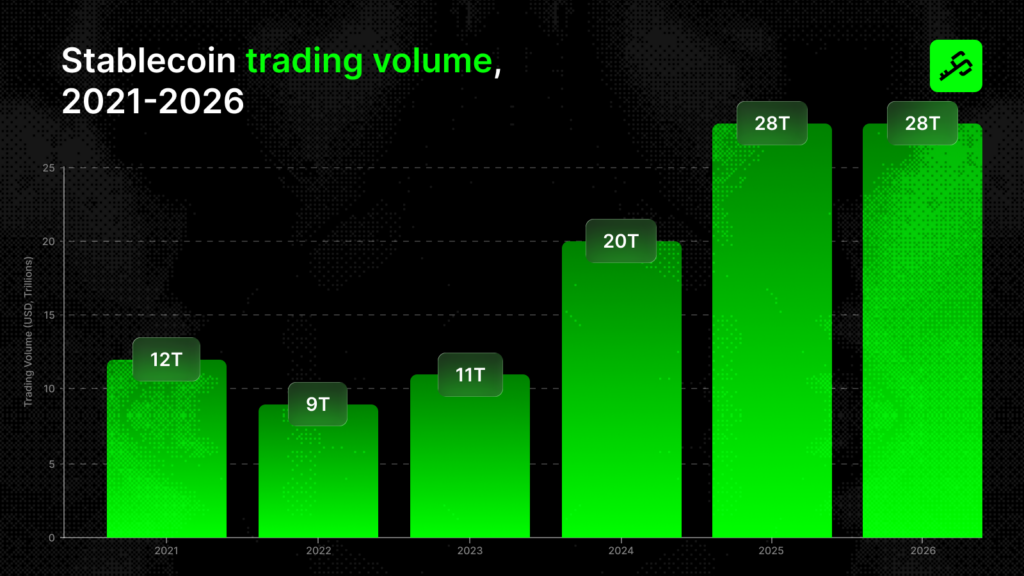
Trading volume is growing even faster than market cap because stablecoins have become the base currency of crypto markets. By Q1 2026, total stablecoin transaction volume reached roughly $28 trillion, highlighting the massive scale of adoption. In 2021, volumes were significantly lower. By 2024–2025, stablecoins had become the standard medium for capital flows between exchanges and DeFi platforms.
By 2026, the market reached record levels thanks to:
- Trading bots
- Arbitrage
- DeFi activity
- Payments
Why Volume Grows Faster Than Market Size
The same stablecoin can circulate many times through the ecosystem in a short period. Traders use them as temporary capital parking. DeFi protocols use them as collateral. Businesses use them for payments.
Additional drivers include:
- Bots and arbitrage
- Transfers between CEXs and DEXs
- On-chain settlements
- Cross-border payments
- Yield strategies and reserve management
Big Money, Big Rules
Banks, payment companies, and asset managers increasingly view stablecoins as tools for cheap settlement and a new generation of digital dollars. That has made the sector systemically important.
Regulation has played a dual role: it limits risky models and requires transparent reserves and it boosts confidence among institutions and accelerates mainstream adoption. The market is not moving toward the disappearance of stablecoins — it is moving toward their transformation into a fully recognized financial instrument.
Final Thoughts
Stablecoins are no longer just a convenient tool for traders. Today, they form an entire financial layer supporting a large share of the crypto economy while building a bridge to traditional money. The market survived crises, removed weak models, and entered a new stage defined by growing capitalisation, massive transaction volume, real-world adoption.
From remittances and trading to salaries and asset management. The most important thing to understand is this: stablecoins are not one product — they are a toolkit for different needs. That is why there are so many of them. The market is not searching for one perfect stablecoin — it is building an ecosystem. Banks, corporations, and governments are already entering this space.
Which means stablecoins are not a temporary trend — they are becoming one of the foundational layers of the future financial system.
Read next

What Is a Token?
Share this post
Link copied!