




Crypto Crime: Scale, Types, and Risks
Cryptocurrency changed the way value moves around the world. Transactions are processed in seconds, borders become irrelevant, and financial tools are available to anyone with internet access.
But those same advantages also attracted the other side — criminals. People who saw blockchain as a new way to make money dishonestly. Today, understanding crypto scams, fraud schemes, and their consequences is becoming a basic skill for anyone working in the industry.
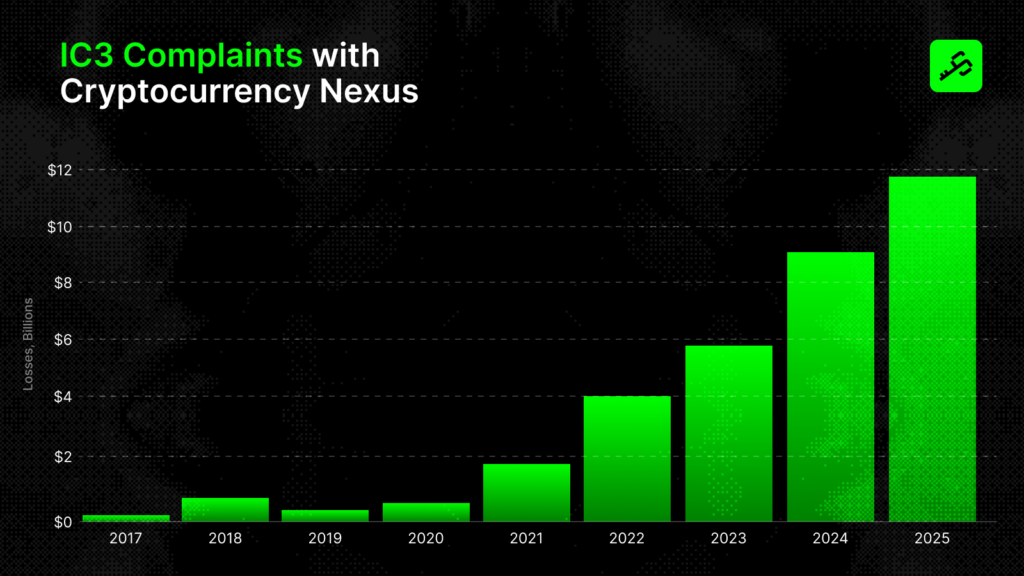
According to the FBI, crypto-related crime has grown significantly in recent years. By 2025, losses in the U.S. alone could reach $11 billion.
What Crypto Crime Is
Crypto crime is any illegal activity involving cryptocurrency. This can include direct attacks on infrastructure, money laundering through crypto assets, or paying for illegal goods and services. That covers everything from sophisticated state-backed cyberattacks to mass fraud against ordinary users.
Types of Crypto Scams
Rug Pull
This is one of the most common crypto scams. Developers launch a project, hype up the token, attract liquidity, and then suddenly disappear with investors’ money.
Most often they:
- aggressively promote the token.
- attract users and capital.
- at some point pull liquidity or dump their own tokens.
According to CertiK, losses from these schemes reached about $85.4 million in 2024.
A classic example is the Squid Game (SQUID) token in 2021. Its price rose by more than 2,000%, after which the developers sold their holdings within minutes, crashing the price almost to zero. Investors, meanwhile, could not sell their tokens because of built-in restrictions.
To avoid a Rug Pull, check the team, tokenomics, and whether liquidity is locked. Avoid hype without fundamentals and don’t ape into suspicious meme projects.
Ponzi Schemes
These are models where returns for older participants are paid from new investors’ money, not from real profit.
In crypto, such schemes often hide behind:
- DeFi protocols with extremely high yields.
- “Innovative” staking pools.
- investment platforms with no sustainable economics.
One of the best-known cases was Bitconnect. The project raised around $2.4 billion, promising daily returns of up to 1%. In 2018, the scheme collapsed after regulators stepped in, leaving investors with multibillion-dollar losses.
A pyramid scheme usually promises guaranteed high returns without a real business model, where older participants get paid not from profits but from new participants’ money. Always check how the project actually makes money.
DeFi Exploits
In DeFi, attackers use smart contract vulnerabilities to steal funds.
The most common methods are:
- flash-loan attacks, meaning instant collateral-free loans borrowed and repaid within one transaction.
- oracle manipulation, where attackers exploit services that feed blockchain data such as exchange rates, asset prices, or event outcomes.
- reentrancy vulnerabilities.
On April 1, 2026, the Solana-based DEX Drift was hacked using social engineering and oracle manipulation. The damage was about $285 million, leading to the loss of more than half of the protocol’s funds.
Your defense against DeFi exploits: only audited protocols, no chasing insane yields, and no keeping large sums in one smart contract.
Cross-Chain Bridge Attacks
Cross-chain bridges connect different blockchains, but they often become weak points. Attacks happen when criminals find code vulnerabilities or gain access to validator keys.
In March 2022, the Ronin Bridge was hacked — the biggest incident in DeFi history. Hackers stole about $624 millionby taking control of 5 of the 9 keys needed to approve transactions.
Bridges are a frequent target. Use only trusted, major ones, don’t keep significant sums there, and move assets between networks only when necessary.
Mixers
These are services that mix funds from different users, making transactions harder to trace. While they can be used for privacy, in practice they’re often used to launder stolen funds.
A notable example is Tornado Cash, which was sanctioned by the U.S. in 2022 after processing more than $7 billion, including funds linked to hacker groups.
Pump & Dump
This is a “pump and dump” scheme, where the price of an asset is artificially driven up and then dumped at the top.
How does it work? A group accumulates a cheap token, aggressively promotes it, creates hype, and sells at the peak. After that, the price drops sharply, and late investors are left with losses. In 2024, the meme coin HAWK, promoted by Haliey Welch, reached a market cap of $500 million, then collapsed by 90% because insiders sold.
Pump & dump works on people who buy into hype. Check who is behind the project and who holds most of the tokens.
Front-Running
This is when someone sees another person’s large trade in advance and gets in front of it to profit from the future price move. In DeFi, this is automated through MEV bots, which monitor the mempool, spot large trades, and insert their own transactions first.
Imagine a user is about to buy $100,000 worth of a token. A bot sees the transaction in the mempool and understands that the price will rise after it. It quickly sends its own transaction first, buys the token, then the user’s trade goes through and the price really does go up. Immediately after that, the bot sells at a higher price and locks in profit. In the end, the user pays more, and the bot profits from the spread.
Front-running bots hunt for large trades with high slippage. Break up purchases, don’t be greedy with slippage, and check the price before confirming.
Drainer Malware
A drainer is malicious code or a smart contract that automatically pulls funds out of a victim’s wallet. You can get hit through phishing links, fake NFT drops, or fake airdrops.
In 2024, total losses from such attacks reached about $494 million, and more than half of the cases were linked to phishing via permit approvals.
Drainers rely on inattention. Don’t click suspicious links, don’t sign transactions you don’t understand, and always carefully check the permissions your wallet is requesting.
How to Protect Yourself
Crypto opens new financial opportunities, but it also creates new risks. As the market grows, scam methods become more sophisticated and the damage becomes larger. Understanding these threats means working with crypto consciously and safely.

Share this post
Link copied!