





Just a few years ago, airdrops looked like a cheat code for the crypto market. All you had to do was actively use a project, and you could receive tokens worth thousands or even tens of thousands of dollars. In 2026, the airdrop market is completely different. Competition has grown, projects have become smarter, farmers more aggressive, and real payouts per user have already declined.
But farming still makes sense. Top-tier projects continue to distribute airdrops — and they’re still doing it generously. In 2025, Story Protocol, Plume, Fogo, Lighter, and Monad delivered solid rewards.
You just need to do it smarter: focus on 5–7 high-quality projects, use tools like the Syndicate app, and avoid spreading yourself too thin.
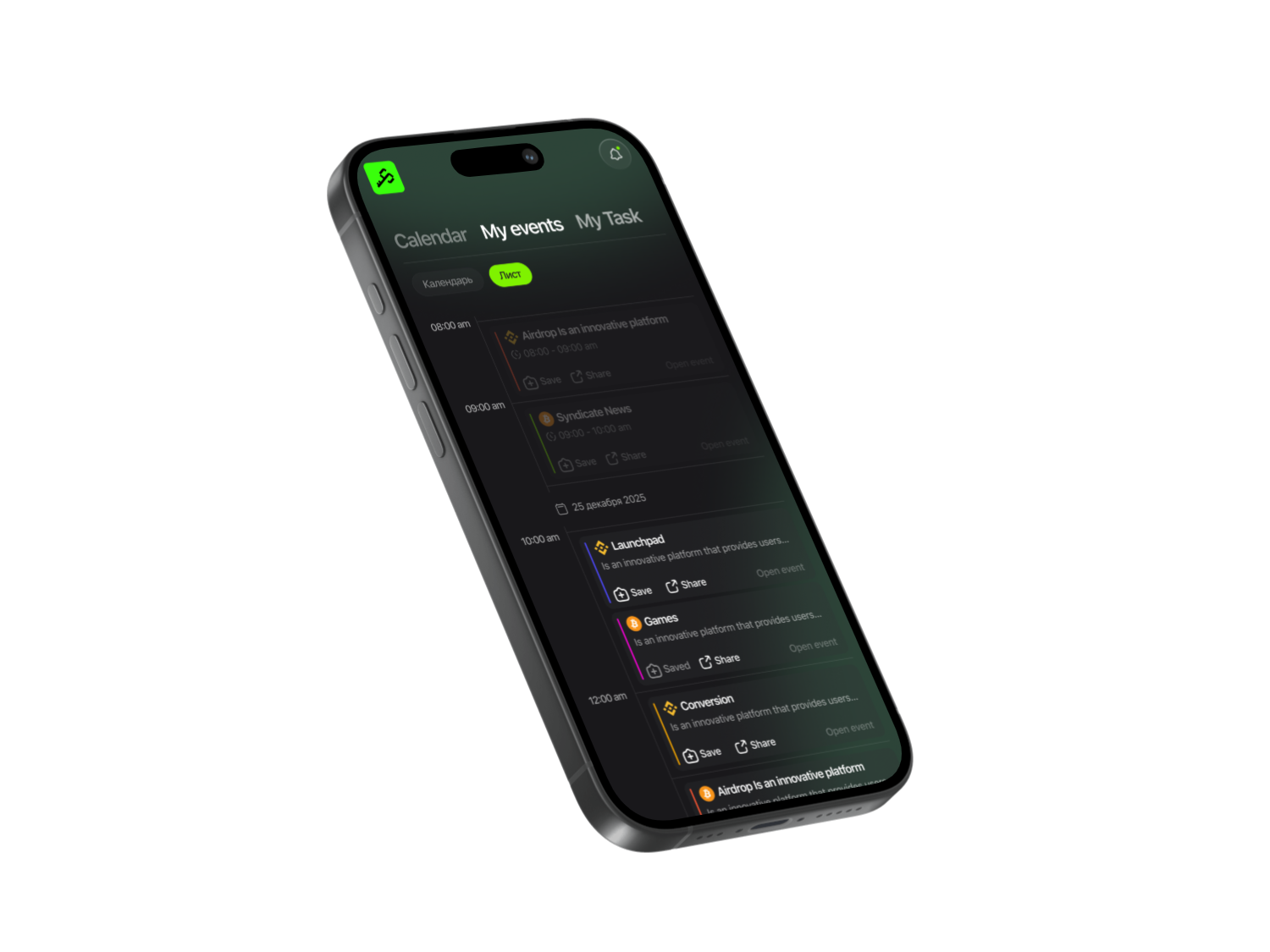
Get More with Syndicate App


If in 2020–2023 airdrops could bring early users significant sums, today they are more often multi-stage campaigns with points systems, Sybil protection, and carefully designed tokenomics. Why has the era of “easy money” ended?
The Biggest Airdrops Ever
Originally, an airdrop was a marketing tool and a great way to build a loyal community. It’s a free token distribution to early participants, testers, active traders, and those who helped the ecosystem grow. Users felt that their time and activity were genuinely valued, while the project gained free promotion and real liquidity. That’s why the biggest drops went down in history as standalone crypto events.
Below are the largest airdrops ranked by total valuation at the token’s peak price — meaning the total dollar value of the distribution.
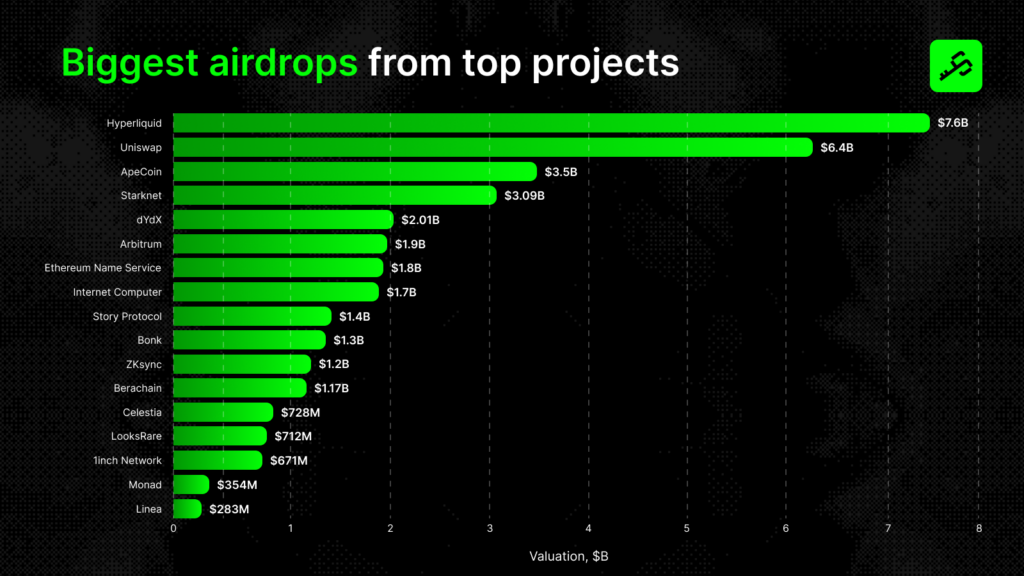
Hyperliquid in 2024 carried out the biggest airdrop in crypto history — $7.6 billion, clearly showing the rise of DEXs and derivatives. Uniswap distributed $6.4 billion worth of tokens in 2020 at peak prices, reigniting interest in DeFi airdrops and becoming a true legend. ApeCoin went even further — in March 2022, BAYC holders received up to $3,5 billion in tokens. The NFT itself was worth around $200k, so entry wasn’t for everyone.
Starknet added $3.1 billion in 2024 as a key Layer 2 project built on zk technology and widely viewed as an infrastructure bet. dYdX distributed $2 billion in 2021 (though with vesting, so not everyone could lock in profits immediately), while Arbitrum secured a top spot with $1.9 billion — a leader in ecosystem growth, liquidity, and broad DeFi usage. Together, these distributions totaled around $24.5 billion.
The combined valuation of crypto airdrops in dollar terms from 2020 to 2025 clearly reflects the cyclical nature of the market.
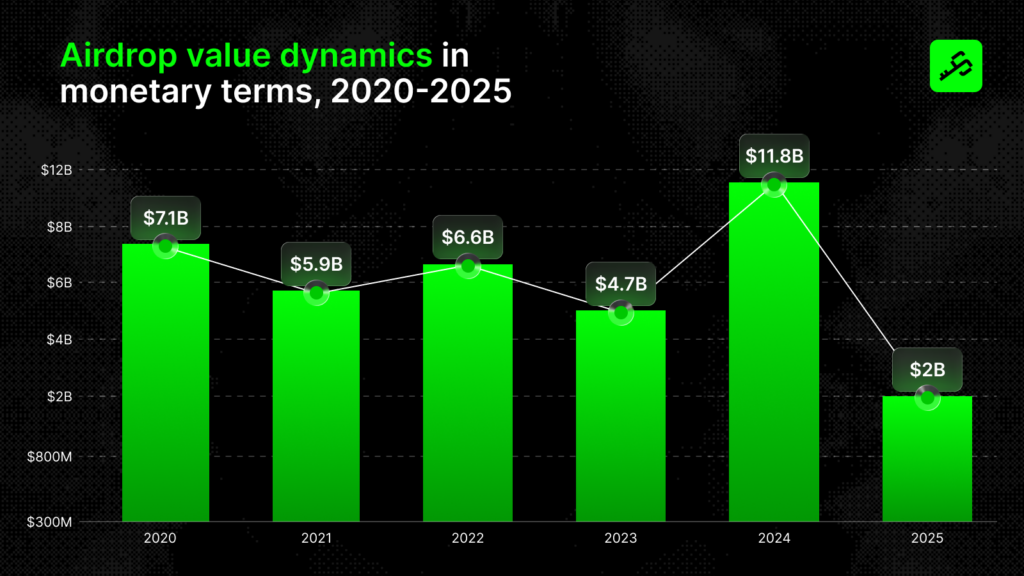
In 2020, due to major early airdrops and the start of the DeFi boom, the market saw a strong start — around $7.1 billion was distributed based on peak token prices. In 2021, despite overall market growth, airdrops became smaller in scale, and annual distributions declined to $5.9 billion. Activity from new protocols and Layer 2 solutions led to a slight increase in 2022, reaching $6.6 billion.
Then in 2023, the total value of airdrops fell to $4.7 billion — the market was going through a bear cycle with lower activity and fewer new projects. In 2024, airdrop volume surged to a record $11.8 billion for the entire period, led by Starknet, Hyperliquid, and zkSync amid a broader crypto market recovery. In 2025, airdrop volume dropped again to $2 billion — possibly because the market cooled after the peak, or because the major 2024 distributions had already exhausted the momentum.
The airdrop market has changed dramatically in recent years. Now millions of users participate instead of the thousands seen in 2020–2021. This is a healthy sign of growing interest in crypto. Reward pools are now split among far more participants, so each individual share of a drop keeps shrinking.
An app like Syndicate helps identify, among hundreds of different activities, the projects that are actually worth farming. To save users time from researching every project independently, we create curated guides that let you complete tasks as quickly as possible and without mistakes. Because before, a few simple actions were enough — now projects use points systems, multi-stage campaigns, and activities lasting several months.
The strategy of projects themselves has also changed. While airdrops used to be a way to quickly attract users and generate hype, today teams distribute tokens more carefully to protect their tokenomics. This creates a stronger community and more sustainable growth. But opportunities always remain for those willing to invest their time and effort.
Share this post
Link copied!