






Exchanges have been part of Bitcoin’s story since the beginning. These platforms created the marketplace where buyers and sellers of crypto can find each other globally. Without exchanges, liquidity would be thin and there’d be no reliable mechanism for discovering fair market prices.
Initially, centralized platforms dominated the market. But technology keeps moving forward, and new tools now let people trade without intermediaries — on decentralized exchanges (DEXs).
What is a DEX?
A decentralized exchange (DEX) is a platform for trading crypto that lets users swap assets directly with one another, without a company acting as an intermediary. In essence, any peer-to-peer (P2P) swap can be described as decentralized trading.
CEX vs DEX — what’s the difference?
On a centralized exchange (CEX) you deposit fiat (dollars, euros, hryvnia) or crypto through the exchange. Once you deposit crypto on a CEX, it’s technically not in your control anymore. You can trade it through the exchange’s interface, but the exchange holds the assets. To use those funds elsewhere, you must withdraw them.
Exchanges keep the private keys for the wallets that store your crypto. When you withdraw, the exchange signs the transaction on your behalf. When you trade on the platform, no on-chain operations actually occur — the exchange simply adjusts balances in its internal database.
Benefits of this model: trading is instant because you don’t wait for blockchain confirmations. Buying and selling is easy, and CEXs typically offer a wider range of trading tools.
Drawbacks and risks: the convenience comes at the cost of custody — you must trust the exchange to safeguard your funds. If the exchange team disappears or hackers breach the system, you could lose your assets.
Many users accept this risk — especially when using reputable exchanges with strong security practices.
The main difference with a DEX is that you retain control of your funds. DEXs run on smart contracts (self-executing programs that follow predefined rules). Unlike a CEX — where the exchange custodys your crypto like a bank — with a DEX nobody holds your assets for you. Trades happen on-chain directly between users, and you keep custody of your funds the whole time.

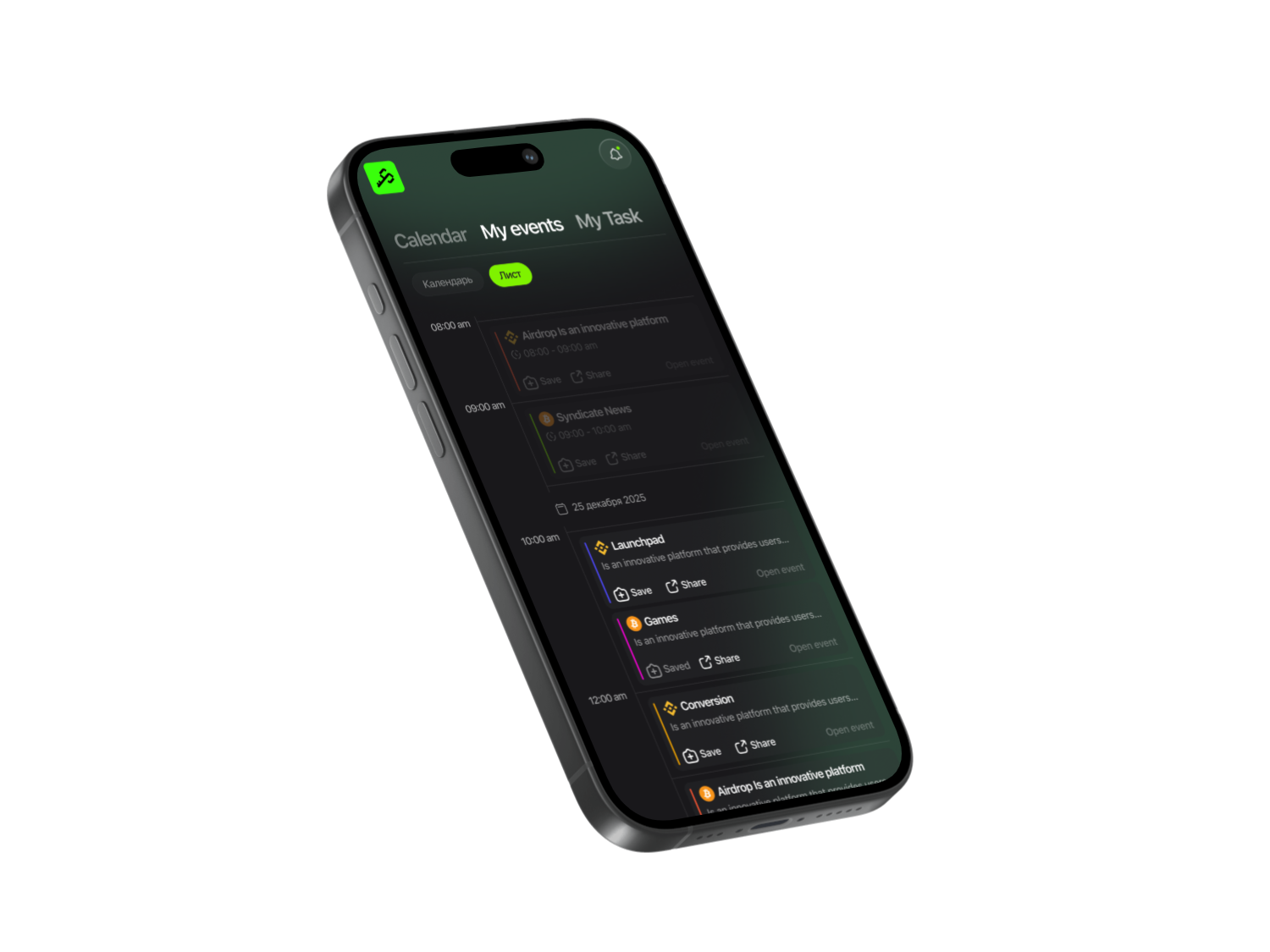
Syndicate – Less Noise, More Action
Never miss an Airdrop with a smart calendar, instant notifications, and community-driven insights.


All DEXs share two core traits with CEXs:
- Trades are executed on the blockchain via smart contracts.
- You always control your funds — nobody can freeze or seize them.
Most DEXs operate on a single blockchain (for example, one DEX might support only Ethereum tokens, another only BNB Chain). Some projects aim to be cross-chain, but the most popular DEXs are typically focused on a single network.
How modern DEXs work
Most decentralized exchanges use liquidity pools — shared reserves of tokens funded by users. The idea is simple: people deposit tokens into a pool, and prices are calculated automatically by a mathematical formula. The main advantage is you can swap tokens instantly without waiting for a matching counterparty at your exact price.
Uniswap, one of the best-known DEXs, uses an automated pricing formula. Users who add tokens to pools (liquidity providers) earn a portion of trading fees, which incentivizes them to supply liquidity. Technically, everything is governed by a set of smart contracts that handle the swaps and rewards.
Modern DEXs are generally straightforward to use. They connect to wallets like MetaMask or Trust Wallet. One important caveat: every trade is an on-chain transaction, so you’ll pay transaction (gas) fees and wait for confirmations.
Popular decentralized exchanges
- Uniswap — a leading DEX that made token swaps simple and accessible with liquidity pools and a clean interface.
- SushiSwap — extended the model with governance tokens and additional incentives for liquidity providers.
- PancakeSwap — runs on BNB Smart Chain (BSC) and typically offers much lower fees compared with Ethereum-based DEXs.
Risks and downsides of using DEXs
- Smart contract vulnerabilities. Bugs or exploits in contract code can let attackers drain funds.
- Low liquidity on less-popular DEXs: the exchange rate may be worse than expected.
- Steeper learning curve for newcomers: you must manage your wallet, safely store your seed phrase, understand gas fees, and know how blockchain transactions work — it’s not as simple as logging into Binance or WhiteBIT.
- Front-running attacks. When you submit a trade on a DEX, it’s visible in the mempool before it’s confirmed. Bots can pay higher fees to jump ahead and capture your arbitrage opportunity.
- High fees depending on the network: during congestion, a single transaction can cost several dollars or much more.
If you decide to try a DEX, start small. Keep private keys and your seed phrase secure, and learn the platform before using significant funds.

Share this post
Link copied!