

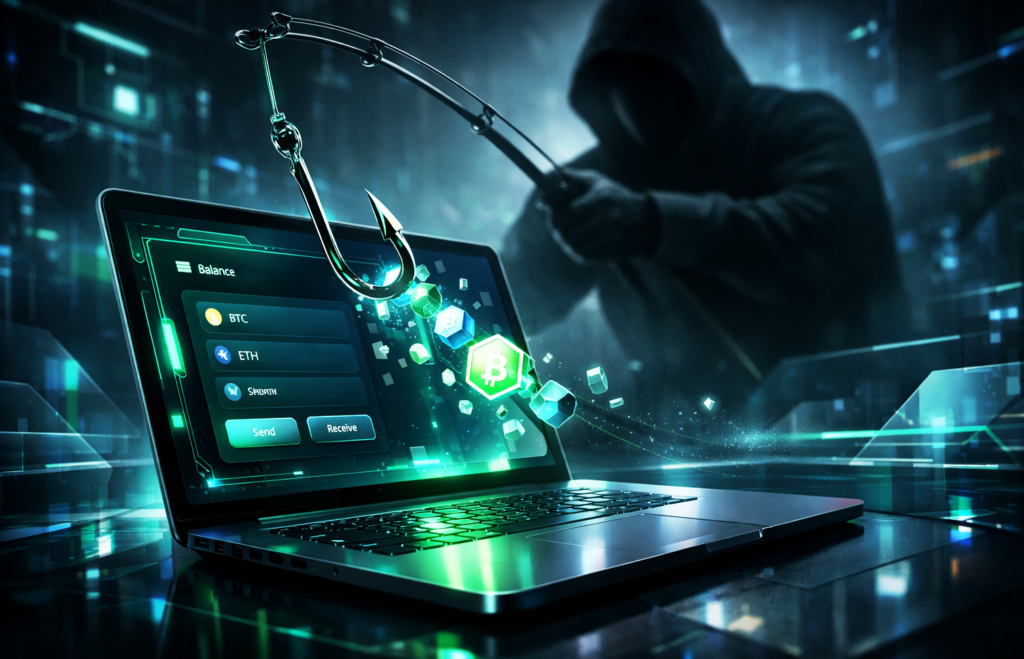



The more popular cryptocurrencies become, the more people want to steal them. How phishing works, what methods exist, and how to protect yourself.
What Is Phishing
Phishing is when scammers impersonate a trusted company or service to trick you into giving away sensitive information: passwords, private keys, seed phrases, or bank card details.
How it happens:
- You receive an email supposedly from an exchange or a wallet
- The email asks you to “confirm your details,” “update your account,” or “verify your wallet”
- You follow a link to a fake website that looks like the real one
- You enter your details — and scammers gain access to your money
At the same time, blockchain transactions are irreversible. If you send cryptocurrency to scammers, unfortunately, it cannot be recovered.
Crypto Phishing: A Special Threat
Crypto phishing specifically targets cryptocurrency holders. Scammers create fake websites of exchanges (Binance, Bitget), crypto wallets (MetaMask, Trust Wallet), or popular projects to steal your private keys or seed phrases.
Blockchain transactions are anonymous — finding the scammer is almost impossible. Beginners often don’t realize how critical it is to keep private keys secret.
How to Recognize Phishing
Phishing uses your trust against you. Scammers pretend to be reputable companies and manipulate emotions to make you hand over your data yourself. At first contact, they pose as legitimate. You receive a message supposedly from an exchange, a bank, or a crypto wallet:
- An email with the Binance or Coinbase logo
- An SMS from “customer support”
- A Telegram message from an “official bot”
- A pop-up window on a website
The message looks real: correct logo, familiar design, professional text.
Then they apply emotional pressure — forcing you to act quickly. The message creates artificial urgency or fear:
- “Your account has been hacked! Confirm your details within 24 hours or you will lose access”
- “You’ve won 1,000 USDT! Claim your prize right now”
- “Suspicious activity detected in your wallet. Verify your account urgently”
The goal is to make you panic and act without checking the authenticity of the message.
Another Method — Fake Links or Files
The message contains a button or link like “Confirm account” or “Claim reward.” It leads to a fake website that looks almost identical to the real one. Differences can be minimal: a slightly different URL binance.com → binаnce.com (the “a” is Cyrillic), metamask.io → metamask-support.com, a slightly different design, unrealistically high returns. You may be redirected to such a site through social media ads, search results, or a link in an email. Always check the website address manually — never click links from messages.
On the fake website, you’re asked to enter your login, password, private keys, or seed phrase.
If you believe it and enter your data on the fake site, scammers instantly gain access to your wallet or exchange account, your private keys or seed phrase, and account passwords. Once they have access, scammers immediately transfer all cryptocurrency to their own wallets, sell your assets, and change passwords so you can’t regain control.
On the blockchain, transactions are irreversible. If crypto is stolen, it cannot be recovered.
Phishing Emails — The Classic Scam
Emails supposedly from real exchanges (Binance, Coinbase) or wallets (MetaMask, Trust Wallet) are the most common way crypto users get scammed. The email usually contains a link to a fake website where you’re asked to enter your login, password, or private keys. Enter the data — and scammers gain access to your funds.
If you receive a suspicious email, don’t click any links. Report it to the exchange’s support team or your email provider — this helps protect other users.
Social Media and Messengers — A New Playground for Scammers
On Telegram, Discord, and Twitter, scammers disguise themselves as well-known crypto influencers, project admins, or exchange support staff. They send private messages offering: “exclusive airdrops,” “help with a wallet issue,” or “unique investment opportunities.” The goal is always the same — to trick you into giving away private keys or sending cryptocurrency to their address.

Important information
Remember: real support teams never message you first and never ask for your keys or seed phrase.
Malicious Smart Contracts — An Invisible Threat
In the DeFi world, a new type of scam has emerged — malicious smart contracts. Scammers create fake tokens or contracts that, once approved by you, can drain all funds from your wallet, lock your assets, or execute hidden transactions.
How it works: you’re invited to join a “new promising project,” connect your wallet, and approve a transaction. After your confirmation, the smart contract gains full access to your funds and instantly transfers them to the scammers.
Fake Airdrops and Giveaways
“Send 0.1 ETH — get 1 ETH back!” or “Connect your wallet and receive free tokens!” — classic crypto scam schemes. Scammers exploit people’s desire to get something for free by creating fake giveaways and airdrops.
Real airdrops never require you to send crypto first, enter private keys or a seed phrase, or sign suspicious transactions.

5 Rules to Protect Yourself from Phishing
- Check website and email addresses. Before entering data on a website or clicking a link in an email, carefully inspect the URL. The same goes for email addresses: a real exchange writes from [email protected], while scammers use [email protected] or [email protected].
- Enable two-factor authentication (2FA). With 2FA enabled on all exchanges and wallets, attackers won’t be able to log in without a second verification via your phone or an app. It’s a simple but powerful layer of protection.
- Store large amounts in a cold wallet. Don’t keep all your funds on an exchange or in a mobile app. Transfer large amounts to a hardware (cold) wallet — a physical device not connected to the internet. Phishing attacks only work online, so a cold wallet reliably protects your assets.
- Ignore unsolicited offers. Legitimate projects don’t message you first and never ask for your secret data.
- Learn and stay informed. Scammers constantly invent new schemes. Read official channels of exchanges and wallets, follow crypto community news, and study real scam cases. The more you know about scam methods, the harder it is to deceive you.
What to Do If You’ve Been Scammed
- Fell for phishing? Act immediately — every minute counts.
- Change passwords on all accounts related to cryptocurrency. If you gave scammers your private keys or seed phrase, urgently transfer all remaining funds to a new secure wallet. Consider the old wallet compromised.
- Contact the exchange or wallet support team and report the incident. Sometimes an exchange can block suspicious transactions or help secure your account.
- Notify your bank if scammers obtained your bank card details. The bank can block the card and prevent unauthorized charges.
- File a report with the police or cybercrime unit. Even if the funds can’t be recovered, your report can help track scammers and warn other users.
- The main thing is not to panic and to act fast. The sooner you respond, the higher the chance of minimizing losses.
How Phishing Has Changed
In the past, phishing was primitive: mass emails full of mistakes, strange links, and texts like “congratulations, you’ve won a million dollars.” Such messages were easy to spot and send to spam.
Over time, scammers became more professional. They learned to copy the design of real companies, use correct logos, and write well-crafted text. Fake emails and websites became almost indistinguishable from real ones.
Today, phishing has reached a new level thanks to artificial intelligence. AI analyzes your social media posts, purchase history, and interests — and creates personalized messages specifically for you. Such messages look so natural that even experienced users may not notice the trap.
Moreover, AI can create deepfakes — fake videos and voice messages. For example, you receive a call from the “exchange CEO” with a video explaining why you urgently need to confirm your details. The voice, face, and manner of speaking look real. But it’s a fake created by artificial intelligence.
The line between real and fake messages is getting thinner. That’s why the golden rule is simple: always verify information through official channels. Technology evolves, and scammers evolve too. But if you know their methods and stay vigilant, your money stays safe.
Share this post
Link copied!