




Airdrop farming (or airdrop hunting) has remained one of the most discussed earning strategies in crypto for several years. Multi-accounting — the attempt to get more tokens through dozens or even hundreds of wallets — became especially popular. But in 2026, the situation has changed drastically: projects have gotten smarter, while competition has become tougher. So, what’s really going on?
Who Are Sybils and What Is Multi-Accounting
Multi-accounting is a strategy where one person creates multiple accounts (wallets) to claim more rewards from a single airdrop. Such users are called sybils.
The term comes from the idea of a “Sybil attack” — when one participant in a network creates many fake identities to trick the system and gain a disproportionate advantage.
In the crypto context:
- 1 person → 100 wallets
- each wallet performs actions
- each one gets the drop
- result: x100 profit
How Multi-Accounting Works
The mechanics are quite simple, but in practice, it requires time and proper infrastructure.
- Creating an account grid with dozens or hundreds of wallets, different IPs, browsers, sometimes proxies.
- Simulating activity to meet retrodrop eligibility: making transactions, using dApps, providing liquidity, participating in testnets. Projects evaluate activity via network snapshots — capturing wallet behavior at a specific moment.
- Receiving the airdrop. If a wallet meets the requirements, it gets tokens.
- Scaling up. The main profit comes from the number of accounts rather than a single wallet.
How Much Do People Earn from Multi-Accounting
In recent years, the market has seen truly “fat” airdrops. Here are the TOP-3 cases from 2023–2025 as reference points for current realities.
- Arbitrum (ARB)
- Minimum ~625 tokens
- Maximum up to 10,250 tokens
- At the peak, the token traded for ~$1–1.5
- Earnings per account: ~$600–$10,000+
- LayerZero (2024–2025, expected/partially realized)
- Farmers created 50–200 accounts
- Аverage payout: ~$500–$2000 per account (community estimates)
- zkSync / Starknet
- ~$200–1500 per wallet
- Multi-accounters made tens of thousands of dollars
How the Share of Sybils Changed
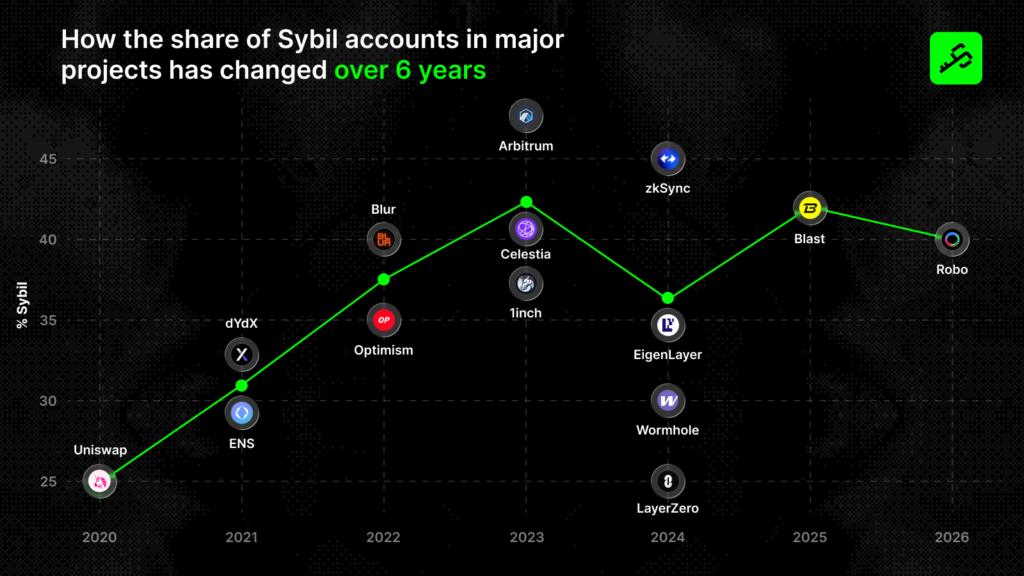
The chart shows the evolution of multi-accounting in top airdrops from 2020 to 2026. The blue line — average share (from 25% up to a 42% peak); red marks — specific projects.
Key takeaways:
- 2020–2021 (Uniswap, dYdX, ENS): ~25–32% — sybils just started out, almost no filters
- 2022–2023 peak (Arbitrum 48%, Celestia 41%): farms took nearly half of the pool
- 2024 mixed results (LayerZero 25% vs zkSync 45%): first anti-Sybil measures appear
- 2026 stabilization (~40%): AI detection + bounty reports filter out 20–30%
The trend is clear: sybils still take around 40%, but the era of “easy” 50% shares is over. Projects are learning, farms are adapting — the arms race continues.
Why It’s Getting Harder for Sybils Every Year
The market has changed. Projects are actively fighting sybils by analyzing transactions, behavioral patterns, and performing wallet clustering. Research shows that sybils often leave identical traces — same transaction types, timing, and activity structure.
Projects now use advanced algorithms: relationship analysis between wallets and machine learning to detect sybils by similar behavior. They do this with over 90% accuracy. Through massive ban lists, thousands of wallets get excluded from airdrops, and sometimes entire farms are wiped out. Projects keep tightening requirements. It’s no longer enough to just make transactions — you need “natural” behavior, a long-term history, and real participation.
Main downsides of multi-accounting in 2026:
- Risk of zero — you can farm for half a year and get nothing
- Rising costs — proxies, gas fees, time
- Heavy competition — millions of airdrop hunters
- Smart anti-Sybil detection systems
Is Multi-Accounting Still Worth It in 2026?
Yes, but it’s no longer easy and not for everyone. For a beginner, it’s mostly unprofitable due to high risk, low ROI, and complex setup. For an experienced farmer, it’s still profitable — if they have infrastructure, masking experience, capital, and time.
In 2026, multi-accounting is no longer the “easy money” it used to be. Projects have learned to detect sybils, airdrops have become more selective, and competition among farmers has intensified. What used to be a “system exploit” is now a full-scale game against anti-fraud systems.
Final verdict:
- For most — not worth it.
- For professionals — still one of the most profitable ways to make money in crypto, but with high risk.
Share this post
Link copied!