





Hyperliquid stands out in the Web3 ecosystem for something most projects neglect — depth of engineering. While competitors competed in the loudness of their decentralization narratives, the team methodically built the product. In a relatively short time, Hyperliquid became the platform of choice for experienced decentralized derivatives traders.
From Harvard to L1: How Hyperliquid Was Built
Behind Hyperliquid are two founders with a rare combination of competencies. Jeff Yan — a Harvard graduate and former quantitative trader at Hudson River Trading — brought an insider’s understanding of how financial markets actually work. His partner, Iliensinc, a distributed systems specialist, complemented this with deep technical expertise. Together they set an ambitious goal: take the best from centralized exchanges — speed and functionality — and combine it with what makes DeFi attractive — reliability, transparency, and the absence of intermediaries.
To execute this vision, the team chose a path most considered too difficult — building their own L1 blockchain from scratch. HyperCore is capable of processing up to 200,000 transactions per second, effectively erasing the experiential boundary between centralized and decentralized platforms. Trading operations require no gas fees — a crucial advantage for active traders, where fees traditionally consume a significant share of profits.
Architecturally, the platform is built on a separation-of-responsibilities principle: HyperCore handles trading and order execution, while HyperEVM unlocks smart contracts and the broader DeFi ecosystem. This hybrid construction allows the system to remain fast where it matters most and flexible where programmability is required.
How a Product Without Marketing Captured 75% of the Market
2024 was the year when the carefully laid foundation began to bear fruit. The team released a series of upgrades called HIP-1 and HIP-2. At first glance they looked like technical details, but in practice they introduced a completely new logic for working with spot assets. From that point on, anyone could deploy a token with a built-in order book — without intermediaries and without complex integrations. The Dutch auction mechanism ensured fair initial distribution, eliminating the typical manipulation problems at launch.
The market reacted instantly. The platform’s TVL, which had recently been measured in millions, crossed $4.5 billion by mid‑2024. This was not a random spike — the numbers reflected real growth in users and trading activity.
By 2025 the scale had become truly impressive. Daily trading volume reached $2.95 trillion, and annual revenue amounted to $844 million — the second‑highest among all blockchains in the world. But the most powerful number is different: Hyperliquid controls 75% of the decentralized perpetuals market. This is dominance achieved not by marketing budgets, but by a product traders consciously choose.
Generosity as Strategy: The Legendary Hyperliquid Airdrop
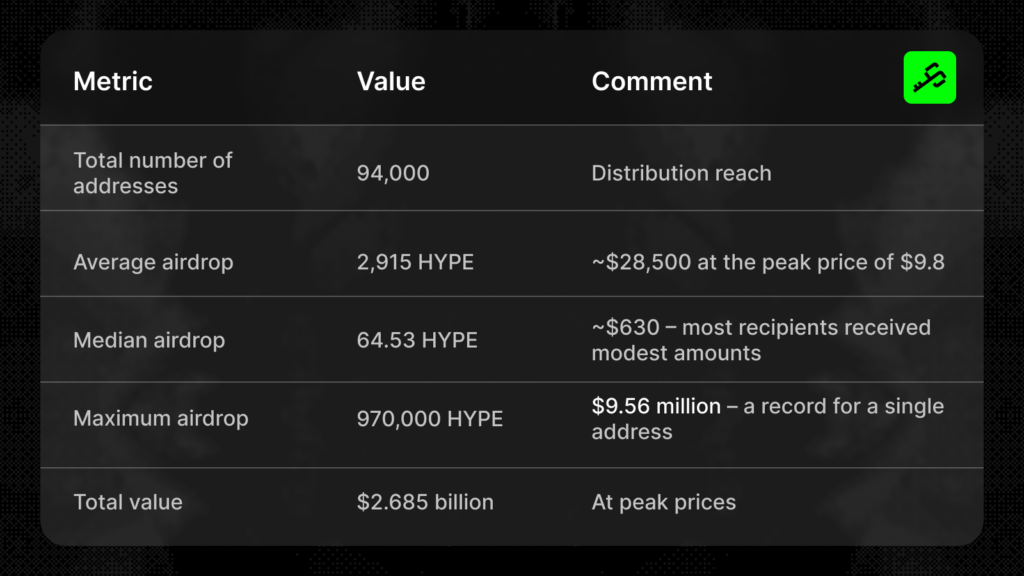
On November 29, 2024, Hyperliquid did something that instantly spread across the entire crypto community — it conducted one of the largest airdrops in the industry’s history. Unlike most similar events that turn into short‑lived hype, this drop had a lasting effect. Early users who had spent years building the platform alongside the team received rewards that reflected their contribution. In just two days, 10,993 new users registered — more than during the entire previous month. The airdrop became not just an act of generosity, but a powerful catalyst for organic growth.
Maturity of the Platform: What February 2026 Showed
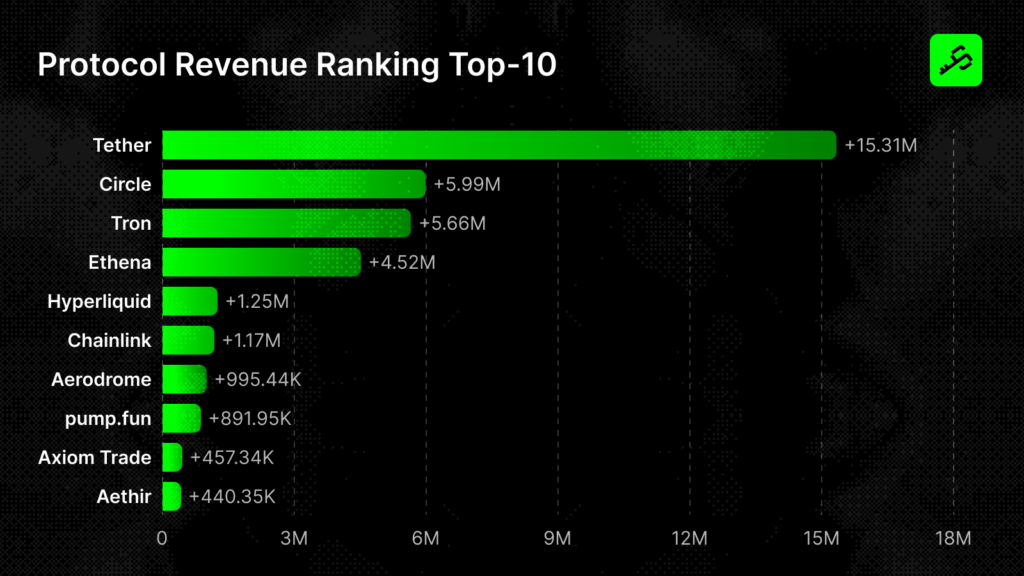
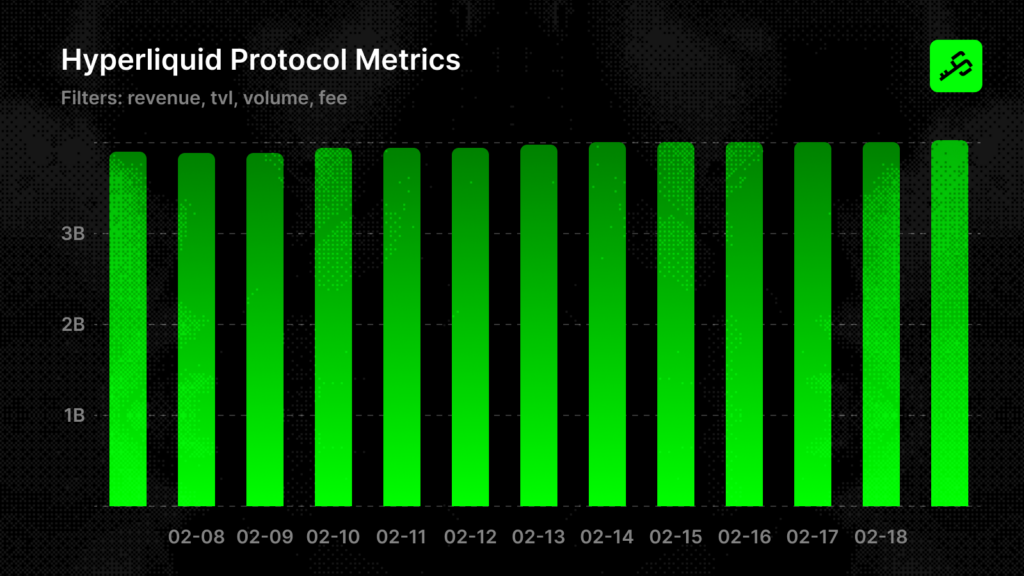
Hyperliquid has become a mature platform with predictable and impressive financial results. As of February 2026, average daily revenue holds at $1.49 million, totaling $19.37 million in a single month. In the overall ranking of blockchain protocols by revenue, the platform takes fifth place — a result that would have seemed impossible for a decentralized derivatives exchange just a few years ago. TVL remains stable in the $3.9–4.0 billion range, indicating strong capital confidence in the ecosystem.
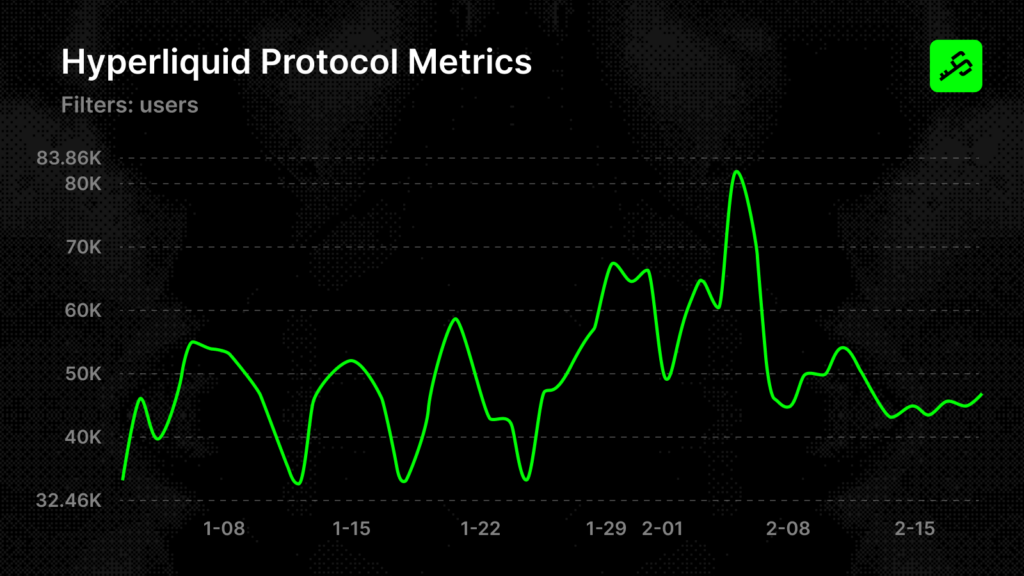
User activity tells an equally compelling story. Each day between 35,000 and 80,000 active users trade on the platform, while the monthly audience reaches around 280,000 unique addresses. Notably, this growth is not a one‑time spike — the platform consistently adds 40–50% new users every month. Such momentum, combined with a solid financial base, makes it possible to speak not just about success but about systemic market leadership.
Antifragility: Why HYPE Behaves Differently
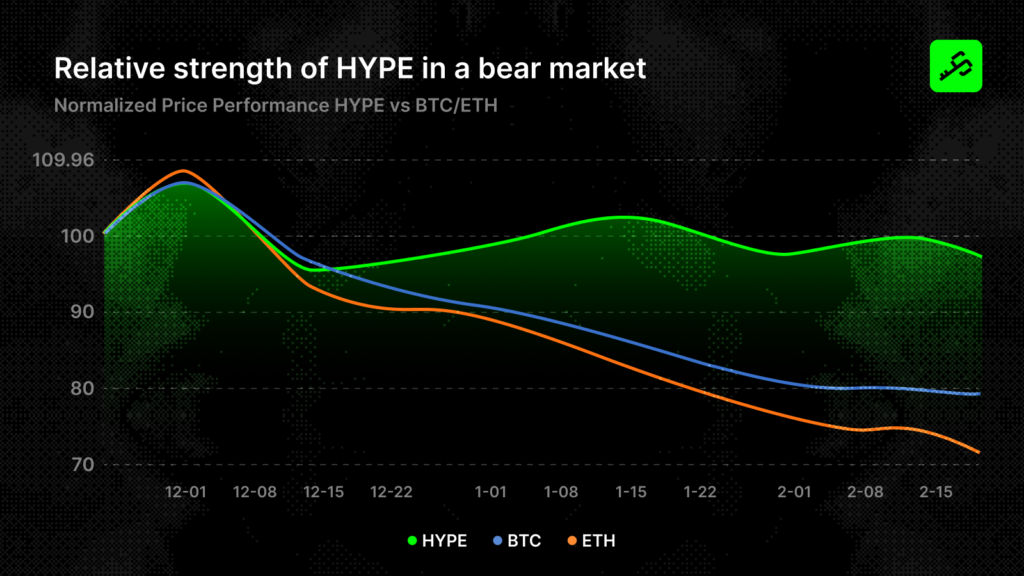
While the crypto market went through a painful correction from November 2025 to February 2026, HYPE demonstrated behavior that forced many analysts to take a closer look. Bitcoin fell by 25% — from $85,000 to $66,900. Ethereum dropped even deeper: minus 35%, from $2,760 to around $2,000. Against this backdrop, HYPE lost only 3%, slipping from $30 to $29. For an asset in a bear market, this represents a fundamentally different behavioral profile.
Such resilience is rarely accidental. It reflects real investor confidence in the protocol’s fundamental value rather than speculative interest that evaporates at the first sign of turbulence. HYPE is one of the few assets that, in a crisis, behaves more like a mature financial instrument than another crypto experiment.
From a tokenomics perspective, the picture also looks balanced. Total supply is 1 billion tokens, of which about 405 million — 40.5% — are currently in circulation. As of February 20, 2026, the token price stands at $29.13, market capitalization at $11.81 billion, and fully diluted valuation at $29.13 billion — numbers that reflect a platform with real market weight.
HIP‑4 vs. Polymarket: Why Architecture Decides Everything
Hyperliquid rarely stops at what has already been achieved, and HIP‑4 is a vivid example. Outcome Trading, the platform’s latest innovation, aims to fundamentally rethink the prediction and derivatives market — a segment that has remained technologically underdeveloped despite massive potential demand.
The essence of the tool is fully collateralized contracts settled within a fixed range. No leverage, no liquidations, with nonlinear payout structures. This makes it possible to create prediction markets and option‑like instruments that were previously unavailable in a decentralized environment. The real advantage over competitors — Polymarket and Kalshi — lies in architectural decisions. Where competitors rely on AMMs with their inherent pricing inefficiencies, Hyperliquid uses an order book. Shared margin with perpetual contracts, integration with HyperEVM for composability, and zero gas fees turn outcome trading from a niche instrument into a full‑fledged part of trading infrastructure.
The practical value is clear in a concrete example. A trader holds a long ETH position with five‑times leverage — a $5,000 position with $1,000 margin. At the same time, they buy an outcome contract on ETH falling below $2,000. The system automatically nets risks between the positions, and the total margin becomes $1,100–1,200 instead of $1,500 or more required across separate platforms. Capital efficiency increases without any additional effort from the trader.
An ecosystem is already forming around HIP‑4. TradeXYZ processes over $12 billion in volume as a leading market provider, QuickNode supplies developer infrastructure, and integration with SEDA Protocol and the Pyth oracle ensures objective and verifiable settlement data. All of this indicates that HIP‑4 is not just a technical upgrade but the foundation for an entirely new class of decentralized financial instruments.
Conclusion and Horizon: Where Hyperliquid Is Heading
Hyperliquid has long moved beyond the definition of a “successful project.” What is happening around the platform is the formation of a new paradigm in decentralized finance built on three interconnected pillars.
The first is technological superiority. A proprietary high‑performance L1 delivers speed once considered the exclusive privilege of centralized exchanges. The second is an economic model that truly works for holders: 97% of trading fees are returned to the ecosystem through aggressive buybacks. The third is a culture of continuous improvement through HIP protocols, each expanding the boundaries of what is possible in a decentralized environment.
Hyperliquid clearly demonstrates a thesis many were reluctant to accept: a specialized protocol that does one thing perfectly can outperform universal blockchains that try to do everything at once. Focus turned out to be stronger than breadth.
Looking toward 2026–2027, the contours of the future are becoming increasingly clear. The share of the decentralized derivatives market will continue to grow, outcome markets will open the door to traditional financial instruments, and with successful roadmap execution the platform’s FDV could reach $50–70 billion. But beyond the numbers lies something more important. Hyperliquid is building infrastructure where speed, security, and innovation are no longer trade‑offs. And that is what makes it not just a market leader, but a benchmark for what DeFi can become.

Share this post
Link copied!