




The RWA sector (tokenization of real-world assets) is experiencing explosive growth. By 2026, its market cap has already surpassed $24B. Even major players like BlackRock and Coinbase have picked up the trend — they are drawn by the ability to make traditional assets more liquid and accessible.
As airdrop experts, we see RWA as the next big narrative after memes and L2s. While TradFi enters blockchain, farmers can take the first positions — and get tokens from projects with billions in TVL. We analyze RWA not just as a trend, but as an opportunity for smart farming in 2026.
What RWA Means
RWA (Real World Assets) is tokenization of real assets on blockchain, when real estate, bonds, gold, or loans turn into digital tokens. In simple terms, you take a “paper” asset from traditional finance (for example, an apartment or U.S. Treasury bond), create a token on blockchain representing its share, and now this token can be traded globally 24/7.
It works by placing the asset into a special fund (SPV), fixing its price through oracles (like Chainlink), issuing ERC-20/ERC-721 tokens, and trading them on DEXs like Uniswap. This solves key traditional market problems: low liquidity (you can’t sell real estate in a minute), high fees (5-10% to brokers), and access only for the rich (minimum lot $1M). RWA lowers barriers, so now you can buy a share in a skyscraper for $100.
Why RWA Is Hyped in 2026
The RWA sector took off thanks to strong interest from major investors. BlackRock has already tokenized $500M in Treasury bonds, and banks like JPMorgan are testing RWA for trading. For the first half of 2026, the market grew 71.4% — from $14B to $24B. The sector’s total growth over three years was 2300%, and excluding stablecoins, the three-year gain was 380%. Regulatory tailwinds are fueling it — the SEC has already approved tokenized securities. And Layer-2 upgrades on Base and Polygon have slashed fees by nearly 99%.
RWA helps solve liquidity problems in traditional finance. Commercial real estate loses about $1T due to banking restrictions, while tokens enable 24/7 trading and fractional ownership. Plus yield: tokenized Treasuries yield 4–5% annually without fees.
RWA Market Growth
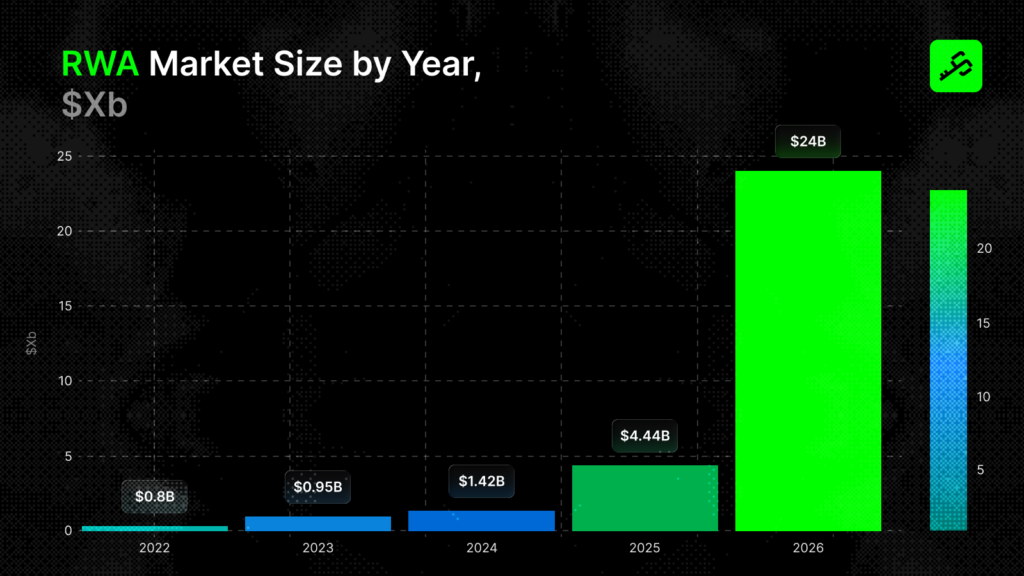
The RWA market grew right before our eyes: from $0.8B in 2022 to over $24B by 2026. Over 4 years, volume increased 30x, and by 2026 it exceeded the $24+B mark. Key growth phases look like this:
- In 2025-2026, the market grew from $4.44B to $24B
- In 2022-2023, the market grew from $0.8B to $0.95B
- In 2023-2024, the market grew from $0.95B to $1.42B
- In 2024-2025, the market grew from $1.42B to $4.44B
Market Cap of Tokenization by Blockchains
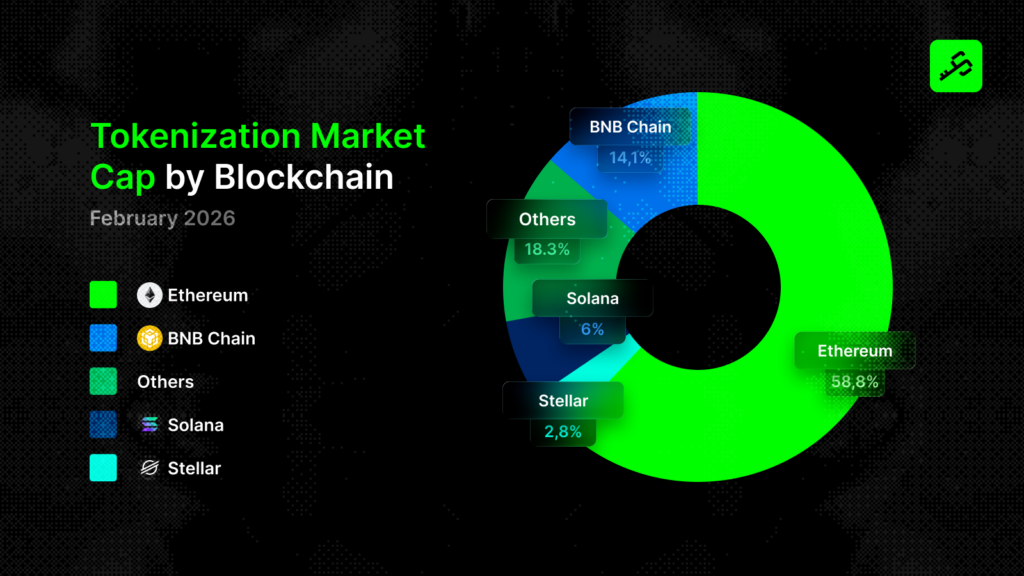
Ethereum remains the leader in tokenization by blockchain — it accounts for about 58.8% of total market cap, or $16.7B. BNB Chain is second with 14.1% ($3.5B), followed by Solana at 6%($1.5B) and Stellar at 2.8% ($722M), while other networks take the remaining 18.3% of the market.
Polygon dominates bonds with over 60% of global bonds. Ethereum is the undisputed leader in Treasuries and credit assets.
Key RWA Assets and Projects
Tokenized U.S. Treasury bonds lead with 54% market share and a volume of about $13B. Private credit and commodities like gold from Tether Gold follow with roughly 40% of the segment.
Top projects set the pace: Ondo Finance with $3.5B TVL, BlackRock BUIDL, Centrifuge (credit specialist), and RealT (real estate tokenization). In 2026, everyone is talking about commercial real estate (CRE) yielding 8–12% annually, with the ability to buy small shares.
Risks and Challenges
RWA projects face stricter KYC/AML rules — complicating access or operations for users. If oracle data like Chainlink is distorted or attacked, token prices will suffer badly. New tokens are often hard to sell without slippage due to weak liquidity. The underlying assets also risk decline — real estate fell about 20% in 2025. Plus smart contract vulnerabilities: bugs and hacks last year caused ~$100M losses. The sector is growing, but it’s far from risk-free.
What Comes Next
The real-world asset tokenization sector (RWA) is moving beyond experiments and becoming part of traditional finance. By 2030, the market could reach ~$30T thanks to interest from major players, clear regulations, and blockchain technology.
In the coming years (2026–2027), major exchanges like Nasdaq will launch tokenized platforms. This will provide 24/7 access to assets, boost liquidity, and cut costs by 30–50%. Investors should look at proven projects on Ethereum and BNB Chain — for example, Ondo, MANTRA, Centrifuge. Better to mix safe assets like Treasuries with high-yield ones (real estate, credit, commodities).
Read next
How OpenClaw Automates Airdrop Farming
Share this post
Link copied!