

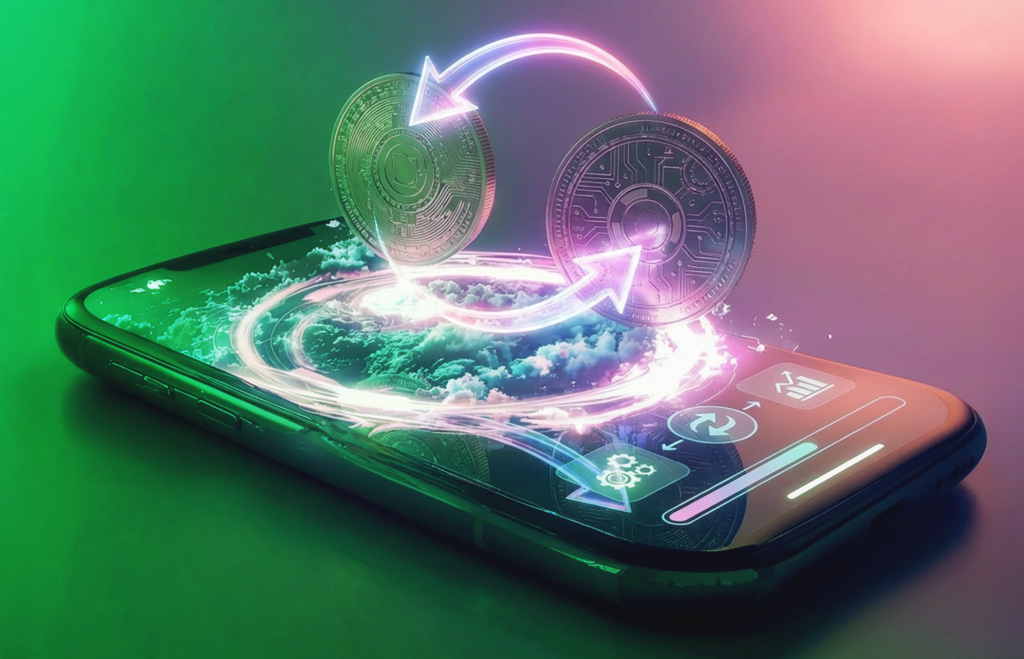



To make this simple and without intermediaries, there’s a mechanism called “swap”. On the surface, everything looks easy: you select tokens and press the “exchange” button. But behind this stands an entire system that automatically finds the best rate and conducts the transaction quickly, securely, and in a decentralized manner.
What Is a Swap and How Does It Work
A swap (from English swap – exchange) is a quick way to exchange one cryptocurrency for another without a classic exchange and order books. Unlike trading on an exchange, you don’t need to wait for a matching offer – the exchange happens automatically. The process is handled by an AMM (automated market maker) algorithm or liquidity aggregator, which finds the most favorable rate on the network. In the AMM model, everything happens through liquidity pools – special “reservoirs” with token pairs, such as ETH and USDC. During a swap, the protocol automatically calculates the exchange rate depending on how many tokens are currently in the pool. The more of one token is bought, the less remains in the reserve – so its price rises slightly.
If the transaction is large, changes in the balance are more noticeable. This is called slippage: the difference between the expected price and the actual transaction price. When the rate is slightly worse because the exchange affects the token ratio in the pool. Thus, AMM allows conducting exchanges instantly, without intermediaries, but the price always depends on the current state of the pool.
During each swap, a small fee is charged, which is distributed among liquidity providers (LPs). Its size is usually around 0.3% or less (depending on the platform). On some networks, users additionally pay a fee for processing the transaction on the blockchain. It can increase during high network congestion. On Polygon, BSC, or Solana blockchains, these costs are significantly lower than on Ethereum, so token exchange there is cheaper.
Advantages and Disadvantages of Swaps
Swaps have several obvious advantages – they allow instant token exchange without intermediaries, have a simple interface, and don’t require registration or KYC verification. Thanks to decentralization, users can perform exchanges directly from their wallet, and many new tokens first appear on DEXs.
At the same time, risks exist: possible smart contract vulnerabilities, fake tokens, or front-running by bots that try to take advantage of your transaction. Special bots notice your future transaction on the network and front-run it, executing a similar exchange earlier. Therefore, it’s important to use verified platforms, carefully check token addresses and swap settings before confirmation.
Share this post
Link copied!